

Get a rundown of 19 of the top fitness trends that you need to know about in 2027. From tech choices to the capacity crunch, and everything in-between! Plus, find out how your fitness business can make the most of the opportunities that these gym trends present.
The fitness industry is always evolving. It’s consistently adapting to changing consumer demands, new technologies, business models, and more. 2027 is set to be another exciting year of change for the industry.
So, what trends can we expect to impact the fitness industry in 2027?
In alphabetical order, we’ve compiled 19 of the biggest fitness trends. All are set to shape the industry in 2027 and beyond.
Let’s get stuck in!
Power up your business & stay in the know
What are the latest fitness trends?
The fitness industry never stands still. As each year passes the industry evolves and adapts to the ever-changing needs and preferences of gymgoers.
In 2027, this evolution will continue to be influenced by a shift in how we view health and fitness. As well as the growing opportunities that technology presents.
At Resamania, we’re lucky enough to work with the most innovative and successful operators around the world. And collaborate with the top industry experts and suppliers.
So, we know what’s happening in the industry. And we’ve created a comprehensive list of the latest trends in the fitness industry to watch.
Check out this quick overview of 19 fitness trends you need to know about (in alphabetical order!). Or scroll down to find out about each fitness industry trend in more detail:
- 24/7 gyms
- AI readiness
- Capacity crunch
- Data-powered growth
- Experience is front and centre
- Fitness as an investment
- Fitness for women
- Group fitness
- Marginal gains
- Mobile apps
- Nurturing communities
- Personal training
- Personalisation
- Revenue diversification & growth
- Revenue optimisation
- Retention matters
- Strength training
- Tech choices
- Wellbeing & health opportunity
19 fitness trends shaping the future of the industry
Let’s explore the continuing and new fitness trends that will shape the future of the fitness industry. These trends are in alphabetical order.

Fitness trend #1: 24/7 gyms
Moving to 24/7 opening and unmanned access control
The fitness market is competitive. Cost pressures have increased. And so, we’re seeing more and more gym operators move towards offering 24/7 access to members. As well as putting in place access control solutions that make unmanned access possible.
Reliable international statistics showing exactly how many clubs are open 24/7 are limited. However, available evidence suggests the model is becoming increasingly mainstream.
- Recent industry data found that 35% of all private gyms and fitness clubs in the UK are now open 24/7
- Major international chains and franchise operators maintain a 24/7 model (like Anytime Fitness)
- Large low-cost (also called high-value, low-price) operators offer round-the-clock access at many locations (like Basic-Fit, PureGym, and Workout Anytime)
Jumping on this gym trend and going 24/7 and/or becoming unmanned can benefit both operators and members.
It can reduce the strain of running a gym for operators:
- Cutting the need to work relentless hours to cover resource and staffing challenges
- Providing a better work-life balance for teams
- And freeing up time to invest into the business, team, and members
Meanwhile, for members this setup can offer ultimate convenience. 24/7 opening lets members work out on their own schedule – perfect for shift workers and night owls!
Curious about switching to 24-hour opening?
Go deeperCheck out this article for pros and cons. Plus, tips on making the transition.
Read now
Fitness trend #2: AI readiness
AI moves from buzzword to reality
AI has featured on just about every industry event stage around the world in recent years. In 2027, it’s no longer theoretical. Industry research shows that in the UK alone, 43% of gym operators are now using AI within their business.
That still leaves a good proportion of operators who’re yet to adopt AI. Why not? Time is the biggest barrier. Over a third of non-adopters say they simply haven’t got the time to investigate the options available.
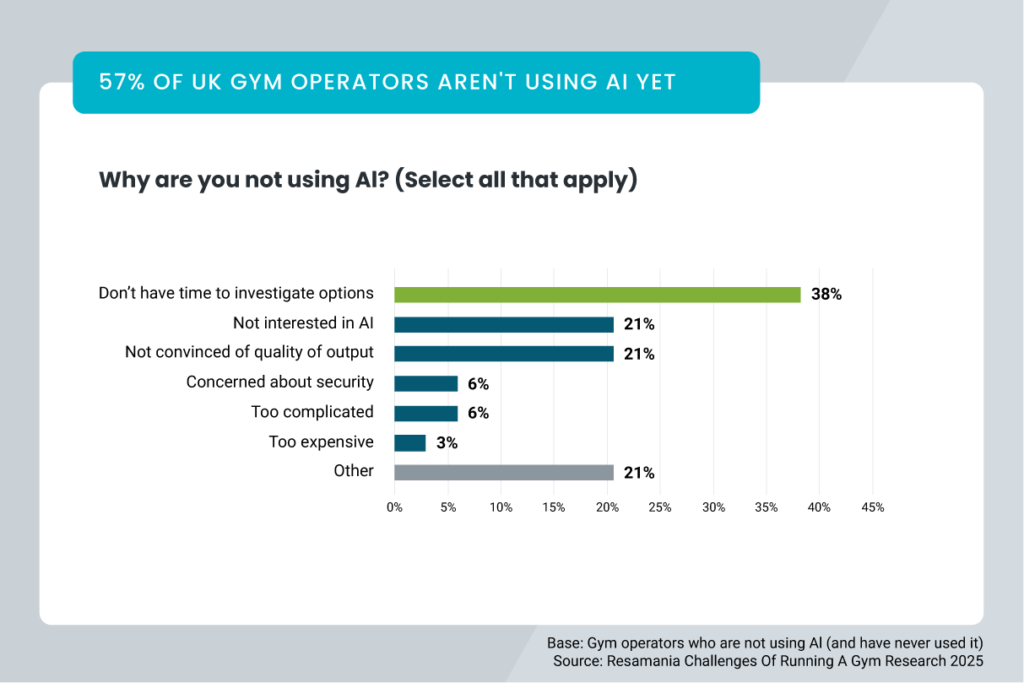
It’s an understandable position when you’re busy and with so many options out there. An ideal starting point for most businesses is to consider whether your current tech setup lends itself to working well with AI solutions.
In other words, are you ready for AI?
Common signs your fitness business is ready for AI
The operators who’re getting the most from AI are the ones who’ve done the groundwork first. Typically, these five factors are in place before AI solutions are introduced:
- Member data is in one connected place
- Processes across the business are repeatable and well-defined
- Key performance indicators are measured and performance understood
- Team members are ready to step away from tedious admin tasks, towards high-value activities
- The business is focused on the long-term
Strategically using AI
Much like with other tech solutions, the operators getting real value from AI are the ones being selective. They are:
- Focused on readiness first
- Picking one clear business challenge to solve
- Choosing a solution that’s tried and tested
- Building from there
AI works best as a partner to your people. AI takes on the repetitive tasks, while your team are free to focus on relationships and service.
For operators running multiple locations, that consistency is often where AI earns its keep fastest. Especially when it’s accompanied by a healthy dose of human judgement. AI can crunch data and spot patterns at speed, while the people in your business bring context and nuance that a model can miss.
How gym operators are using AI today: 5 practical use cases
Go deeperAI is here. More operators than ever are finding impactful ways to apply AI within their businesses. Are you? Find out how to make AI work for your business and explore the 5 impactful use cases of AI for gym operators.
Get stuck in!
Fitness trend #3: Capacity crunch
Usage is up, capacity is becoming a challenge
Across the globe, many operators are experiencing a similar scenario. More members are visiting more often and for longer.
Fitness leaders at PerformX Live 2026 described this moment in time as a golden age for fitness. Memberships are gradually shifting from a discretionary spend to something members now consider an essential investment.
The UK Health & Fitness Market Report 2026 from ukactive recorded an annual 10.3% year-on-year increase in visits. Meanwhile, the Health & Fitness Association reported that visits to US commercial fitness facilities reached nearly 7 billion in 2025 – surpassing the pre-pandemic record set in 2019.
Increased usage is a positive problem, albeit also a genuine one. Several big-name operators have already hit capacity in parts of their business. Some have responded with capped memberships and waitlists to protect the experience for existing members.
Navigating the capacity crunch
The operators managing this well are focusing on:
- Yield over volume – building a loyal member base that stays longer and spends more
- Secondary spend – offering bolt-ons and extras that let members customise their experience (and boost revenue without accommodating more members)
- Smarter use of space and time – reviewing floor layouts, adapting class programming, and using usage data to encourage visits more evenly across opening hours
If capacity is becoming an issue for any part of your business, it’s time to consider how you address this using the space, time, and data you already have. Understand what “full” means for your business and carefully decide how you want to respond to it.

Fitness trend #4: Data-powered growth
Using data to power growth
Competition is high. 76% of UK gym operators say that they face local competition. And 51% of these operators say members are switching to competitors, while 54% are targeting the same demographics.
To tackle this challenge, many operators are getting savvy to creatively use data within their businesses. By embracing data, operators can retain a larger membership base and increase average member lifetime value.
Where to start with this fitness industry trend
Compared to businesses that don’t use data, data-driven businesses are:
To start, use data to power your marketing. Look in your gym management software. Identify where, when, and how you market your business. Send personalised, targeted emails and texts to prospects (and members).
Next, use data to refine your offering:
- Look at bookings and visits data. Do more of what’s working and less of what’s not
- Add new class and small group fitness formats
- With your membership base in mind, add new health and wellbeing offerings to be upsold to members, as well as attracting new audiences
Using your data in this way can help you win more new members with an expanded, improved offering.
Start small to make it manageable. Then, review on a regular basis, for example quarterly or even monthly.
When you’ve won members, use data to create personalised onboarding journeys. Send targeted, tailored communications at key times. Focus on getting members into the habit of visiting 4-12 times a month.
Give as many new members as possible an induction of some type. Using body composition tools can help you gather data at the start of a journey. Track improvements for each member based on their goals.
Your access control set up should automatically track visits. Set your system up to identify when visit habits change and members stop showing up. Re-engage these at-risk members with a personalised approach using the data from your CRM and other systems.
Finally, when members leave, record reasons why in your gym management software. You could additionally use detailed exit surveys. Review this data and find ways to rectify addressable issues.

Fitness trend #5: Experience is front and centre
Members expect outstanding experiences (even on a budget)
Competition is growing. Operating costs have risen. And consumers are accustomed to high-value experiences, even when they’re paying a low cost. Gyms and fitness clubs are being challenged to double down on member experience.
Members anticipate a consistent, easy experience that meets their expectations every time – both in-person and online.
With over 700 locations worldwide, low-cost, high-value chain PureGym knows how to create consistent experiences at scale. Speaking at the HCM Summit, PureGym COO Rebecca Passmore shared valuable insights into doing this even when operating costs keep growing.
“If you’re gonna be hit by a barrage of costs… you just can’t pass all of this on to your members. You’ve got to build a war chest. You’ve got to build resilience. And you’ve got to be focussed on driving efficiency without compromising that customer experience.”
Rebecca Passmore, Group Chief Operating Officer at PureGym (speaking at the HCM Summit)
By continuously refining their model and looking for new ways to use tech to enable and support a low-cost business model, PureGym delivers experiences that attract and retain members.
“At PureGym, we’ve effectively echoed the supermarket checkout model. We’ve driven significant efficiencies through the use of technology, saving on labour costs whilst really ensuring that we don’t compromise that member experience in our value proposition.”
Rebecca Passmore, Group Chief Operating Officer at PureGym (speaking at the HCM Summit)
Tech powers consistently high value experiences
Whether you’re operating a chain of low-cost gyms or luxury health clubs, experience matters. And strategically using tech can help you create experiences that are memorable for all the right reasons.
Your gym management software should adapt to your business needs to deliver joined-up member experiences. Make the most of the integrations and partnerships your software offers to create your signature member experience.
For example:
- The Resamania and Club Perks integration makes it easy for operators to enhance their member experience. How? With access to a highly curated selection of relevant perks and discounts directly within the member app
- The Resamania and HealthKey integration lets operators offer members instant access to over 300 preventative health and wellbeing services. So, creating the opportunity to enhance memberships (and even offer access as a paid bolt-on)

Fitness trend #6: Fitness as an investment
Mindsets shifting to view memberships as an investment
In many ways, the future of the fitness industry is being influenced by this next trend.
Traditionally, people have judged gyms and fitness clubs based purely on price. A membership fee can be seen as a cost to be paid for a commodity and gymgoers often watch for bargain deals.
This has kept prices low. And that impacts your ability to build a profitable business and invest in future improvements and innovations.
Increasing prices can improve profitability
Tip71% of gym operators who’ve put up prices report improved profitability
Get more insightsWith operating costs rising, operators are recognising the need to take prospective and current members on a journey.
A journey that shifts mindsets away from viewing a membership as a commodity. Towards viewing a membership as an investment. An investment in their future health. An investment that’s worth paying a little extra for.
Take your members on this journey to viewing fitness as an investment
Price is a barrier to joining gyms and fitness clubs. A consumer poll conducted for the Gym Membership Sales Report research found that:
- Over half of respondents had been put off signing up for a gym membership due to cost and perceived value for money
And price is a reason for quitting. The Gym Operator Insights Report found that (where leaving reasons are recorded at least occasionally):
- 44% of operators say it’s very common or common to hear members can’t afford their membership due to the rising cost of living
- 33% very commonly or commonly hear that members can’t afford their membership due to job loss or redundancy
How do you overcome price as a barrier to joining and staying? You need to convince your prospects and members that a membership is a worthwhile investment.
“I think as long as you invest in it all the time, engaging with your membership and offering them what you want, people will pay for it.”
Jack Burton, Fit24, at the Gym Operator Conference
You need to sell the value you provide to prospective and existing members. To be successful in doing this, you need to:
- Know what members really value
- Meet and exceed member expectations
- Offer something members can’t get elsewhere
“We’ve now brought in a Club Plus membership. So, for an extra £25 a month it gives members access to our boutique type of services… We’ve grown our membership base from 7,000 to just under 8,000. And our club plus is about 1,000 members, so we’re getting an extra £25,000 a month through now offering these services.”
Sean Thornton, 3-1-5 Health Club, at the Gym Operator Conference
How to increase gym membership prices (and keep members)
Go deeperNervous about increasing prices? Want to maximise retention and minimise attrition? Get expert tips for smooth price increases.
Get stuck in!
Fitness trend #7: Fitness for women
Helping women overcome barriers to fitness
Women’s health has moved to a mainstream priority for the fitness industry.
The Global Wellness Institute named 2026 as the year of women in wellness. With women typically spending more on health than men and growing scientific focus on female-specific health, this is one of the clearest opportunities for our industry.
And it’s already playing out on the ground.
People are searching online for terms relating to women’s gyms and fitness. For example, global Google Ads data for the year to end-August 2026 shows impressive year-on-year growth:
- 433% increase in searches for ‘women only fitness club’
- 84% increase in searches for ‘gym only for women near me’
- 60% increase in searches for ‘women’s fitness gym’
- 55% increase in searches for ‘gym with women’s section’
- 53% increase in searches for ‘nearby gym for women’
- 22% increase in searches for ‘ladies only gym’
- 22% increase in searches for ‘women’s gyms’
- 22% increase in searches for ‘best gym for women near me’
Creating welcoming spaces
In recent years, big-name gym brands got serious about helping women overcome barriers to fitness. In 2027, this gym trend will continue.
UK-based big-box gym chain, Total Fitness, chose to make a location women-only. The brand invests in extensive audience research and identified the need for a space just for women. A space where women’s fitness is taken seriously and normalised.
“It was challenging for me.
It’s been a journey for a couple of years and the first challenge was actually recognising it was a thing. I’ve trained in gyms for 25 years, and I was the first one to cause the problem, and say it was not a thing. But the customers told us they needed it, so we walked towards that debate which is a bit difficult.
It is a bit difficult, particularly for a woman CEO, it feels like a commercial pet project. But it’s absolutely not.”
Sophie Lawler, CEO of Total Fitness at PerformX Live
Total Fitness’ dedicated Women’s Gym concept reached capacity, with the operator introducing capped memberships and a waitlist to manage demand and protect the experience.
Other operators are carving out space for women in existing locations. International HVLP chain, PureGym, now has some clubs that offer women’s workout spaces. To date, these have proven popular and are attracting in more women.
Meanwhile, UK-based low-cost chain The Gym Group partnered with The Well HQ to create the Female First programme.
This equips gym staff with specialist female fitness knowledge and the skills to translate this on to the gym floor. Beyond this, The Gym Group runs female-only Weights For Women training sessions.
Whether you’re opening a women-only club, creating a dedicated area for women, or introducing classes just for women, there are many opportunities to play your part in this trend. And ultimately, help women feel comfortable in a gym environment.

Fitness trend #8: Group fitness
Maximising the power of classes
Some of the fitness industry trends listed here can be effectively delivered to members via group fitness classes.
Group fitness classes made it back on to the ACSM’s Fitness Trends list for 2026. Coming in at position 13, it’s the first time since 2019 that classes made the list. And for 2027, the trend has risen to position 7.
The revenue potential of classes
43% of operators surveyed for the Fitness Industry Growth Report 2027 report that classes are currently a growing revenue stream.
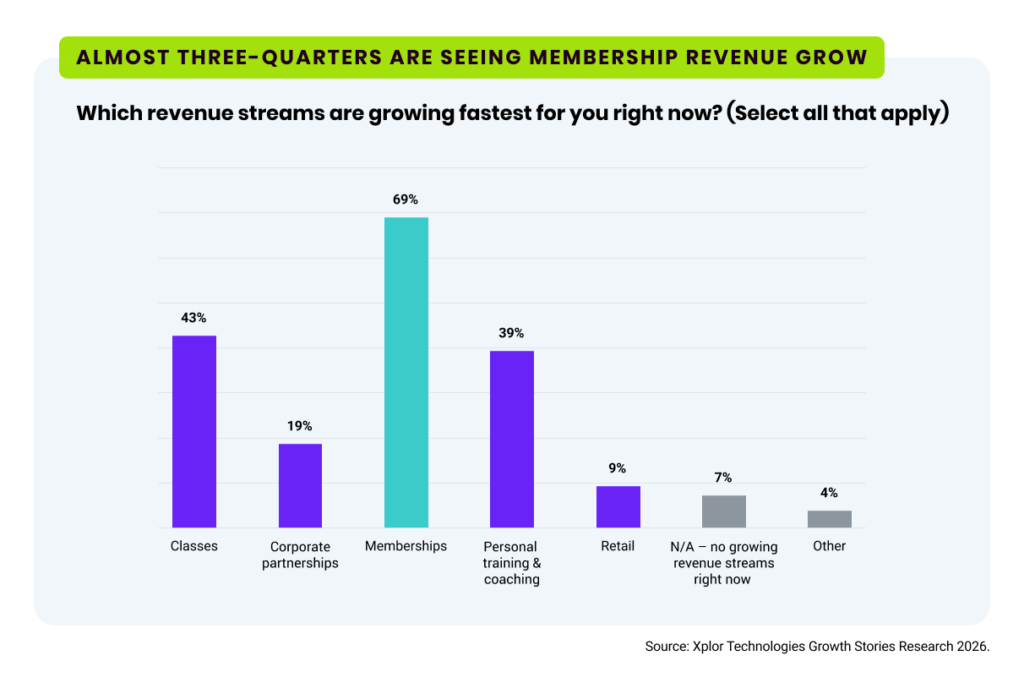
Classes can also boost membership revenue. Les Mills research has shown that members who do 2 group fitness classes a week will stay longer than those who don’t. And a longer length of stay equals a greater member lifetime value. So, increasing gym profitability.
Making group fitness classes more profitable
In 2027, there will continue to be renewed focus on running group fitness in a profitable way. Try:
- Tracking the impact of increasing the number of members at your club, visit frequency, and retention
- Setting short-term targets on a quarterly basis for every class you offer – base these on the previous quarter
- Getting buy-in from instructors to build accountability
- Regularly analysing results – look at your best-performing instructors, class types and time slots
- Consulting stakeholders, including participants and instructors, when making changes

Fitness trend #9: Marginal gains
Small improvements add up a big impact
For the first time since 2019, commercial/multipurpose big box gyms made the ACSM Health & Fitness trends list. Landing in position 19, this reflects a growing appreciation for larger scale gyms offering a mix of facilities and services.
With competition remaining fierce and member expectations continuing to rise, it’s no surprise that marginal gains will be a key focus for gym operators in 2027.
The idea, made famous by the British Cycling success story, is simple. Find small, 1% improvements across multiple areas of your business. Then watch them add up to big results.
Keep looking for small changes to make
For gym and fitness chains, that might mean:
- Adding an extra touchpoint or a new level of personalisation to your member onboarding journey
- Using data to fine-tune class timetables based on attendance patterns
- Streamlining staff rotas for better coverage during peak periods
- Making small tweaks to your website to improve visibility across search and AI
Each change alone may feel minor. But together they deliver significant long-term gains in member satisfaction, retention, and revenue.
The aggregation of marginal gains has, in part, helped PureGym achieve impressive growth over the last decade.
“Humphrey [Cobbold, former CEO and now Chair of PureGym] drove a brilliant culture throughout our organisation of marginal gains. He really coached us to look for that additional 1% improvement.
And do you know what? We do that every day. Whether that be studying heat maps of the gym floor to ensure that kit quantities are right – 24 treadmills, 12 treadmills. 10 bay lifting rack, 12 bay lifting rack. We try lots of different bits of equipment, booty builder, the new latest innovative kit coming out of Matrix. Or even getting the hot, trending reformer classes, to go in our Danish business at the moment.
We study the font, the font size, the selection of images on our latest digital adverts, and we test wording in our latest CRM campaigns to ensure that we’re really increasing open rates and decreasing opt-out decisions.
Whilst each of these individual decisions may seem small in the grand scheme of things, each individual one really does add up. And it really does create momentum and drive the business forward. Sometimes further forward than you actually might realise.”
Rebecca Passmore, Group Chief Operating Officer at PureGym (speaking at the HCM Summit)
The good news is that making marginal gains is something every operator can do. No matter the size of your business or your operating model, there are always improvements that can be made with a test-and-see approach.
In 2027, the most successful fitness operators will focus on continuous improvement across every part of their operations.

Fitness trend #10: Mobile apps
Powering better member experiences
A gym member app is nothing new. But even so, mobile apps have earned their place on the list of the latest fitness trends for 2027.
Consumers are continuing to demand apps from businesses. Research has found that 64% of consumers prefer to use an app rather than visiting a website through a mobile browser.
And building on this preference for apps, the most recent ACSM worldwide health & fitness trends survey placed mobile exercise apps at #2 in the top 10 list.
January is the most popular month to download a mobile fitness or workout app. Globally, in January 2026, the 15 biggest fitness apps saw over 18 million downloads.
Make your app the go-to for members
Your members are looking to you for an app. One that does everything they need to get the most out of their membership – and more.
Make the most of this opportunity. Choose a gym membership app that includes handy integrations. So, members don’t need to keep switching apps.
For example, integrations that make it easy to offer tailored exercise and nutrition support. Help them make the most of their training sessions with relevant workouts to follow. And even provide them with nutrition support to enhance the results of those workouts.
Elevate your digital fitness journey
TipEngage your members with a custom-branded gym member app. Members can use your app to manage memberships, book classes, access your club, and more.
Learn moreFitness trend #11: Nurturing communities
Looking for connection through fitness
People of all ages are looking to meet new people and feel part of a community by joining a gym. This is an important fitness industry trend for operators to pay attention to.
Social isolation and loneliness are widespread. The World Health Organisation reports that 16% of people worldwide experience loneliness – that’s one in six people. Loneliness particularly impacts younger people – between 17-21% of those aged 13-29 report feeling lonely.
Connection is an essential need. Fitness businesses can create strong communities and forge meaningful connections amongst members.
Gym and fitness clubs are evolving to become social spaces and community hubs, uniting like-minded members. Research from Nuffield Health shows that an increasing number of people use fitness as an important part of their social life:
- 52% of those who are part of a fitness community say their social life has improved – and 46% feel less lonely
- 72% of remote workers say workouts improve their social wellbeing
- 25% of men surveyed say exercise is their primary social outlet
- 33% of those aged 25-34 say exercise helps them meet new people
Find ways to build lasting connections between members. And you’ll be able to make the most of the business opportunity this presents.
Events are bringing people together
Fitness events are one of the most visible signs of this trend. From the phenomenon that is HYROX to the ever-popular Parkrun, participation is growing. Google Ads keyword data shows that in the year to end-August 2026, more people around the world were Googling a range of fitness event-related terms, for example:
- Searches for ‘HYROX fitness race’ increased by 400%, for ‘HYROX’ increased by 124%, for ‘HYROX competition’ increased by 83%
- Searches for ‘ATHX games’ increased by 235%
- Searches for ‘tough mudder 5k’ increased by 116%
For many gymgoers, events are a social opportunity. A chance to train towards a common goal with others. You can support this with event-specific training programmes and small group sessions for members preparing for the same race.
Community isn’t just about competition
Let’s face it, not everyone wants to race. Many members simply want a friendly, welcoming way to get moving and meet people. The good news? There are loads of ways to build community without bringing competition into the mix. For example:
- Run, walk and cycle clubs – Launch clubs affiliated to your gym locations. Open them to members only, or to the wider communities in the areas you operate within to reach new people. Walking clubs can be a particularly effective way of reaching new demographics
- Social meet-ups – Coffee mornings after classes, post-run breakfasts, or social drinks. Give members a reason to stay and chat
- Beginner courses – Run courses like beginner Pilates or beginner strength training over a set number of weeks. The same group attends each session (your software should make this easy to set up). So, members learn together and build friendships along the way
- Small group training – A coach, a consistent group, and shared goals. It’s a great way to create accountability and connection
- Buddy schemes – Help new members bring a friend or get paired with someone at a similar stage working towards similar goals
- Challenges – Run gym challenges that members can take on together, whatever their fitness level
Making it work
Follow these tips to get your community nurturing initiatives off the ground:
- Start small and make it regular – A weekly meet-up beats a one-off event
- Make newcomers feel welcome – Have a friendly face (like a coach or instructor) lead and introduce people
- Use your social channels – Create groups so members can stay in touch between sessions
- Celebrate progress – Shout about milestones of all kinds
- Use your club management software to manage bookings and communications for clubs, courses, and events in one place
13 fitness event ideas to boost business
Go deeperLearn the basics of event planning and get 13 fitness event ideas.
Read now
Fitness trend #12: Personal training & coaching
Elevated personal training experiences
Almost every year (with the exception of 2026), personal training features in the ACSM’s Health & Fitness Journal® worldwide survey of fitness trends. For 2027, it bounced back into 14th place.
39% of gym operators surveyed for the Fitness Industry Growth Report 2027 said personal training and coaching is one of their fastest growing revenue streams.
There have been many sessions at key industry events talking of the overwhelming scale at which inaccurate health and fitness info is proliferated online. Fuelled by algorithms across social networks, search engines, and AI platforms.
Operators and specialist practitioners can set the record straight.
Your personal trainers and coaches can play a big part in getting the right info out there. So, educating consumers with the facts and providing personalised guidance based on individual member circumstances.
Make personal training work for your business
Exactly how gyms work with personal trainers (PTs) differs business to business. Some directly employ PTs. Others charge PTs rent to train clients. And others will take a % of the revenue PTs earn training clients at their gym.
Each different approach comes with pros and cons. There is no right or wrong approach. You need to do what suits your business. What’s clear are the benefits that personal training can bring to your gym business.
Offering personal training to members will help them follow a structured programme to achieve their goals. And enjoy expert guidance along the way to avoid injury.

Fitness trend #13: Personalisation
Using tech to engage & deliver personalised experiences at scale
Another top fitness industry trend for 2027 is the increased need to use technology to engage members. And deliver the levels of personalisation members demand, consistently and at scale.
Research has found that 81% of consumers prefer personalised experiences. Worldwide, the hyper-personalised fitness market is growing at an 18.9% compound annual growth rate (CAGR) from 2026 to 2036.
Embracing personalisation in 2027 will really set you apart from the competition. And could even improve performance and profitability.
Power personalised experiences at scale
Operators have a wealth of data available today. And this data can be used to create personalised, engaging member experiences. Inspiring and encouraging members to visit more often.
For many independent gyms, there are massive gains to be had from embracing tech in new ways. Tech, like gym management software, can help you deliver consistent experiences at scale. This, in turn, makes retention easier.
Similarly, you can use tech to power gamification which boosts engagement. Gym challenges are an easy entry point into gamification.
The power of personalised digital fitness experiences
Go deeperReady to find new ways to harness the power of tech to create a highly personalised fitness experience for members?
Get stuck in!
Fitness trend #14: Revenue diversification & growth
Diversify & grow revenue – even in unpredictable times
In 2027 and beyond, you’ll need to think outside the box. Thinking differently will help you adapt to ever-changing demands. And build a thriving business.
The global economy has faced major uncertainty in 2026 and recent years. From higher energy prices to increased staffing costs, operators in many markets are experiencing ongoing financial strain.
And that’s forcing operators to get creative and explore new ways to attract revenue. You need to make the most of every opportunity that presents itself.
Traditionally, gym memberships have been subscription-based. And that’s great for:
- Bringing in predictable revenue
- Building longer-term member relationships
- Delivering value for money
Building predictability in unpredictable times
Go deeperFind new ways to grow recurring revenue and accurately forecast financial performance.
Get stuck in!Increasingly, gymgoers are seeking more flexibility from clubs. So, more fitness businesses are going beyond subscriptions to offer other membership and access options.
Common alternatives include:
- Annual and shorter-term paid-in-full memberships
- Pay-as-you-go memberships
- Day/week passes
- Packs & bundles (e.g. 10 coaching sessions or 12 Pilates classes)
- Corporate partnerships
- Aggregator access
6 ideas to help you build loyalty and desirability
Go deeperExplore the benefits of diversifying beyond subscriptions. And build predictability with practical tips to help you attract and keep casual members coming back.
Read nowAdd high-demand formats that members will pay extra for
Adding popular activities and services that members will pay extra for can create new revenue streams. Helping you attract new customers and give existing members reasons to stick with you.
Three to consider are:
1. Small group personal training
Small group training sessions can be held on the gym floor, making them a simple addition for many operators.
Google Ads data shows that global searches for ‘small group personal training’ grew by 23% in the year to end-August 2026.
Plus, searches for related terms grew over the same period too. For example:
- ‘Small group classes’ grew by 256%
- ‘Small group PT sessions’ grew by 233%
- ‘Small group exercise classes near me’ grew by 133%
2. Pilates & reformer Pilates
If you have studio space and access to suitable instructors (and potentially the ability to install reformer beds), Pilates has experienced a boom in recent years.
Google Ads data shows that global searches for ‘Pilates studio near me’ grew by 124% in the year to end-August 2026, and ‘Pilates classes near me’ by 83%. Related terms saw healthy growth too:
- ‘Reformer based Pilates’ grew by 256%
- ‘Gyms with reformer Pilates’ grew by 177%
- ‘Best Pilates classes near me’ grew by 49%
With this high-demand activity, you could also consider adding classes or courses for specific target groups. Google Ads data for the year to end-August 2026 shows growth in these related terms:
- ‘Beginner Pilates near me’ grew by 22%
- ‘Pilates for beginners over 60’ grew by 53%
- ‘Pilates for over 50s near me’ grew by 29%
- ‘Pilates for men’ grew by 22%
- ‘Pilates for runners’ grew by 26%
- ‘Pilates for golfers’ grew by 22%
3. Padel
You need the right space for this one. If you have significant unused or underused spaces, or are looking at new locations in 2027, it could be worth considering if it fits with your business proposition.
The Playtomic Global Padel Report 2026 indicates there are over 58,000 padel courts worldwide – up 16% year-on-year. Meanwhile, Google Ads data for the year to end-August 2026 shows global searches for ‘padel near me’ have increased by 22%.
Recurring class or course memberships
TipAdding Pilates or small group training to your timetable? Consider using your gym software to offer a series of recurring classes or sessions on a membership subscription basis. Automatically book members onto all sessions included when they sign up.
See this in action – book a demoPut your space, brand, and audience to work
Beyond adding high demand activities, think about other ways you can attract different sources of revenue into your business.
Ideas to explore include:
- If fitness professionals and influencers use your space, consider making the most of this by charging for filming
- Hire out space such as studios, courts or meeting rooms to local businesses, instructors, and community groups
- Adding retail items and/or food & beverage. Products that solve a specific member need often sell well
- Youth and family programmes, like holiday camps and swim lessons
- Sponsorship and in-club advertising with local and national brands
- Workshops and events that bring in members and non-members alike
Making diversification work across multiple sites
For chain and franchise operators, the challenge is often making diversification work across locations with consistency and profitably. An approach like this can help:
- Start with data – Look at usage by site, day and time. Identify spare space and quiet periods
- Pilot, then scale – Test new ideas at one or two locations. Track revenue, visits, and retention before rolling out
- Standardise what works – Create playbooks for pricing, formats, and set-up that sites can replicate
- Localise where it matters – Demand varies by market, so adapt offers to local audiences
- Protect the core – Make sure new offers support your membership base rather than cannibalise it
- Use joined-up tech – Your gym management software should handle multiple pass types, packs, and recurring bookings across sites in one place

Fitness trend #15: Revenue optimisation
Maximising membership revenue through smarter payment collection
As well as looking to diversify revenue sources, in 2027 another fitness industry trend moving firmly into the spotlight will be revenue optimisation through smarter membership payment collection.
For the vast majority of operators, memberships are a vital source of recurring revenue. The reality is simple. To grow revenue, you need to successfully collect the income you’ve earned.
It’s valuable to regularly review payment strategies, reduce preventable collection failures, and give members more ways to pay, while maintaining predictable recurring revenue.
As both competition and operating costs remain high, many operators are looking for opportunities to create marginal gains across their business (as highlighted earlier in this fitness trends list).
Membership payments present a key opportunity here. Small improvements to collection processes can reduce involuntary churn, improve cashflow, and create smoother experiences for members.

Fitness trend #16: Retention matters
Growing costs put a premium on retention
Research spanning 19 countries and over 180 gym operators, published in the Fitness Industry Growth Report 2027, found that almost 60% have seen the cost of winning new members increase in recent years.

When acquisition costs rise, it pays more than ever to double down on keeping the members you already have. That’s why retention makes it onto the list of fitness industry trends for 2027.
The research also demonstrated that focusing on retention can help you achieve your growth goals. Of operators who’ve experienced growth in the last 3 years, 57% say retention has contributed to that growth.
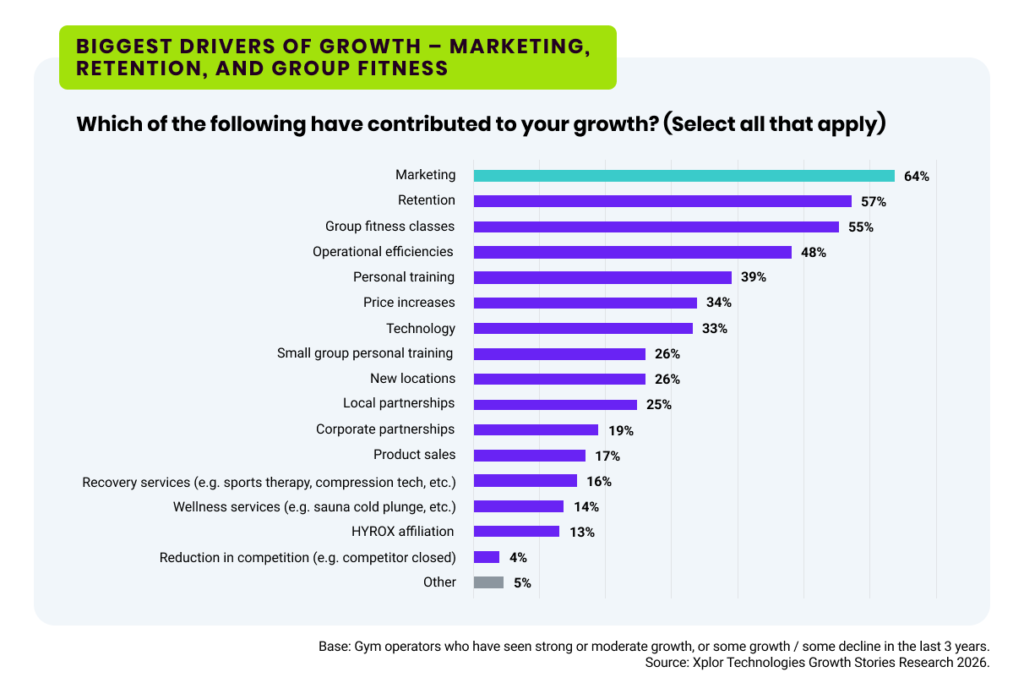
Reduce the number of members leaving and increase the length of time members stay, and you’ll grow member lifetime value. All while reducing the volume of new members you need to pay to attract.
Focus on visits as the shortcut to retention success
The key to member retention is visits – members who visit regularly are likely to stay with your business for longer.
For brand new members, attending once a week is often enough to help start building the habit of visiting. For others, two to three visits a week will be completely achievable. Building an achievable visit habit is essential.
Continuously cheer on members to make that next visit. An easy starting point is adding celebratory email messages to your automated onboarding journey. Send these when members hit key visit milestones.

Fitness trend #17: Strength training
More people seek out strength training
Strength training with free weights or machines improves and maintains muscular fitness. The most recent ACSM worldwide survey put traditional strength training with free weights at position 5. This enduring fitness trend looks set to continue into 2027.
Google Ads keywords data shows that worldwide interest in strength training is high. Over the year to end-August 2026, searches for specific terms particularly increased:
- ‘Strength training gym near me’ searches grew by 392% year-on-year
- ‘Weight training classes near me’ searches grew by 133% year-on-year
- ‘Strength training classes near me’ searches grew by 83% year-on-year
- ‘Strength training for women at gym’ searches grew by 57% year-on-year
- ‘Senior strength training near me’ searches grew by 50% year-on-year
More people want to reap the rewards of getting stronger
So, it’s clear, gymgoers have grown more aware of the benefits that strength training offers. Research continues to show the positive impact it can have on:
- Muscle size and strength
- Cardiovascular health
- Bone density
- Joint stability and protection
- Mental wellbeing
- Body fat percentage
- Sleep quality
Strength training is most effective when executed with proper form. You can help your members reap the rewards of strength training with proper form through:
- PT sessions
- Small group training
- Group fitness classes

Fitness trend #18: Tech choices
Operators get serious about selecting tech
Tech adoption is by no means a new fitness industry trend. Yet it’s been a topic of renewed interest in 2026 and into 2027.
From AI to software and everything in between, many fitness industry events and trade shows are adding more tech-focused talks and panels to their line-ups.
83% of gym operators face some sort of tech-related challenge.
Many of these challenges can be overcome by slowing down when selecting and introducing new solutions.
Take it slow when introducing new tech solutions
How do you make sure you invest your attention, time, and money into the right tech solution for your business? Start by taking a step back.
Think about your end goal. Where do you want your business to be in 5 years? The tech you choose should help you get towards that goal. And it needs to have the longevity to meet your needs as your business and the market evolves.
Set aside time to do your research. Look for solutions that are complementary to existing systems. And streamline where possible.
A new tech solution can give you the chance to start over. Work with suppliers to find new ways of doing things optimising processes and even solving problems you don’t know you have!
Give yourself extra time when rolling out a new solution to really nail the detail. Consider testing the solution at a pilot location before rolling it out across all the clubs within your business.
Set aside time for teams to learn the software and take part in training. Test everything and find out how to use your solutions effectively before going live.


Fitness trend #19: Wellbeing & Health
Mindfully seek opportunity in wellbeing & health
Over the last six years or so, consumers have become more knowledgeable about wellbeing and health than ever before. The business of wellbeing and health has been a hot topic in the fitness industry too.
And that’s why it’s a fitness trend to pay attention to in 2027. One thing is clear, as Oliver Patrick (Future Practice) said at PerformX Live, it’s time to stop waiting and start acting.
“When we look at the world of wellcare and healthcare, we’ve got to stop waiting for medicine to anoint us. To colour with a prophet oil, put it on our forehead and say ‘you are worthy to receive the sick and rehabilitation pathways, you’re worthy to take my clients and improve their wellbeing from a state where it is not so well.
We have to go direct to the consumer, because for the last 20, 25, 30, 35 years we’ve been waiting for medicine to fill out gyms, to fill our facilities and they’re not doing it.”
Oliver Patrick, Future Practice at PerformX Live
Where to start with the wellbeing opportunity
Wellbeing is not a golden ticket. You need to start by mastering the fundamentals of fitness – retaining members with services that solve their needs. Then you’re ready to work out which protocols and services make sense for your business.
Recovery is often a starting point. There are 8 modalities that can work effectively for gyms and fitness clubs:
- Diagnostics (e.g. Body composition, blood testing, etc.)
- Nutrition (e.g. supplementation, food prep services, etc.)
- Compression (e.g. HydraBeds, massage chairs, etc.)
- Temperature (e.g. Cryotherapy, saunas, etc.)
- Photobiomodulation (e.g. Red light beds and pods)
- Pulsed electromagnetic field therapy (PEMF) (e.g. BEMER therapy, iMRS prime, etc.)
- Oxygen (e.g. Hyperbaric chambers, ozone therapy, etc.)
- Medbeds
But where do you start with choosing the best modality for your business? Look at:
- Your local market and your current membership base
- Space limitations of your facilities
- Skills of your team (you may need modalities that don’t rely on staff)
- The upfront and ongoing investment required
- Your business model and pricing strategy
How do you get members to commit? Structured programmes tend to work well.
4-week programmes, for example, as this timeframe is doable for the average person. The price point is normally affordable. And it is enough time to start building relationships and having an impact.
With the right approach, adding wellness to your offering will help you attract more members, increase average transaction value, and encourage more frequent spending.
The wrap up…
There you have it! 19 fitness industry trends for 2027 (in alphabetical order) that gyms need to pay attention to.
If you can keep on top of these fitness trends, you’ll be set up for success in 2027 and beyond.
Choose gym management software that will help set your fitness business up for success.

by Ollie Flegg UK Commercial Director – Gym & Payments at Resamania
-
First published: 16 November 2026
Written by: Ollie Flegg