

The fitness industry doesn’t stand still, and neither should you. From the panels at key industry events to the data behind the headlines, these are the 5 trending priorities every gym operator needs on their radar.
2026 has been a big year for fitness so far. Demand is strong. The conversation around AI has moved from “should we?” to “what first?”. And gymgoers are more engaged (and more discerning) than ever.
Staying ahead means separating genuine shifts from short-lived noise.
So, we’ve pulled together 5 of the biggest priorities that have been shaping the industry so far in 2026. See what they mean for your business and how you can respond.
Let’s get stuck in!
Power up your business & stay in the know
1. Tech that actually delivers on its promise
Nearly every gym relies on technology to run day to day, from membership management to access control and marketing automation.
Adoption doesn’t automatically equal success.
Recent research shows that while almost all gym operators use tech, 1 in 5 have found it hasn’t lived up to expectations. And 82% report at least one tech-related challenge, whether that’s poor integration between systems, slow adoption from members and staff, or simply not knowing which solution is right for the business.
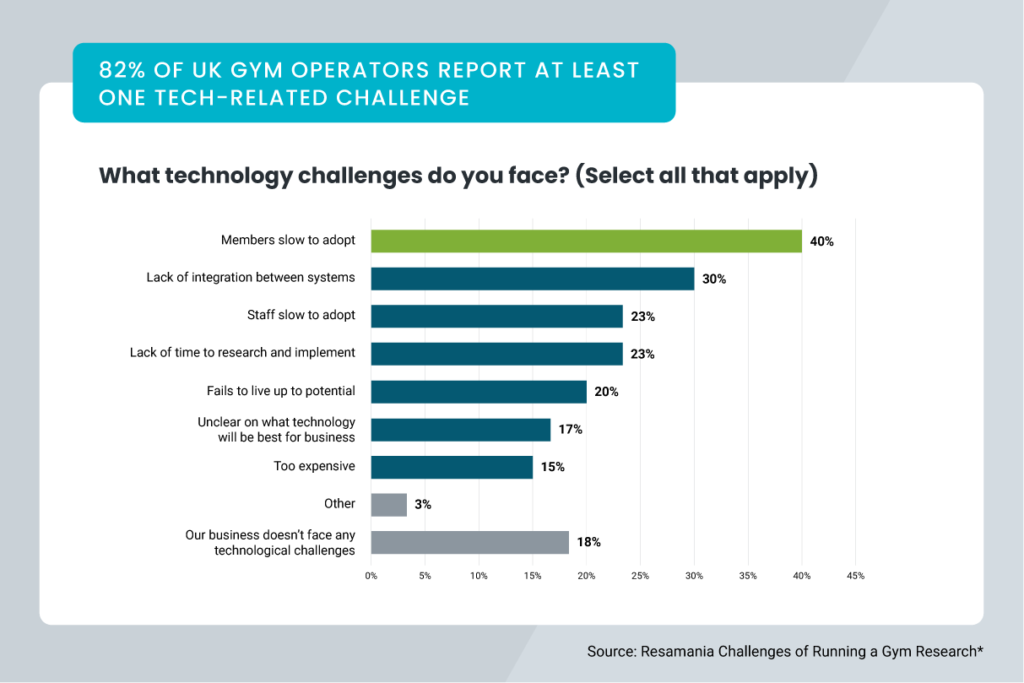
The issue is rarely the tech itself. More often, it’s unrealistic expectations about what a new system can deliver, and how quickly.
Setting realistic expectations
Operators seeing the best return share a few habits in common:
- They frame the problem before shopping for a solution. That means asking where they’re losing time, where members experience friction, and which processes won’t scale
- They think beyond today’s needs. That means choosing platforms that can support new locations, services, and integrations down the line
- They treat rollout as a people project as much as a technical one. That means planning sufficient training, appointing internal champions, and allocating enough time for adoption
When it’s chosen strategically and given the runway to embed properly, tech is a genuine growth enabler.
The right solution is the one that solves a real problem you’ve identified, integrates cleanly with the systems you already rely on (or replaces them), and can grow alongside your business. Choosing a partner who supports you before, during, and after go-live tends to matter just as much as the platform itself.
2. Usage is up, and capacity is the new challenge
Across the industry, many operators are experiencing a similar scenario: more people are visiting more often, staying longer, and spending more once they’re there.
Gym leaders at PerformX Live 2026 described it as a golden age for fitness. Memberships are gradually shifting from a discretionary spend to something members now consider essential.
ukactive’s UK Health & Fitness Market Report 2026 recorded an annual 10.3% year-on-year increase in visits. Meanwhile, the Health & Fitness Association reported that visits to US commercial fitness facilities in the last quarter of 2025 were up 4.2% year-on-year.
Increased usage is a fantastic problem to have. It’s also a genuine one. Several well-known operators have already hit capacity in parts of their business. Some have responded with capped memberships and waitlists to protect the experience for existing members.
Navigating the capacity crunch
The operators managing this well aren’t just chasing membership numbers. They’re focusing on:
- Yield over volume – building a loyal member base that stays longer and spends more
- Secondary spend – offering bolt-ons and add-ons that let members customise their experience (and boost revenue without adding headcount to the gym floor)
- Smarter use of space and time – reviewing floor layouts, adapting class programming, and using usage data to divert visits more evenly across opening hours
If parts of your business are starting to feel the squeeze, it’s time to get sharper about how you use the space, time, and data you already have. Know exactly what “full” means for your business and decide deliberately how you want to respond to it.

3. AI moves from buzzword to daily operations
AI has featured on pretty much every industry event stage in recent years. What’s changed is that it’s stopped being theoretical. Industry research shows that 43% of gym operators are now using AI within their business.
That still leaves 57% who aren’t, and time is the biggest barrier. Over a third of non-adopters say they simply haven’t had the time to investigate their options.
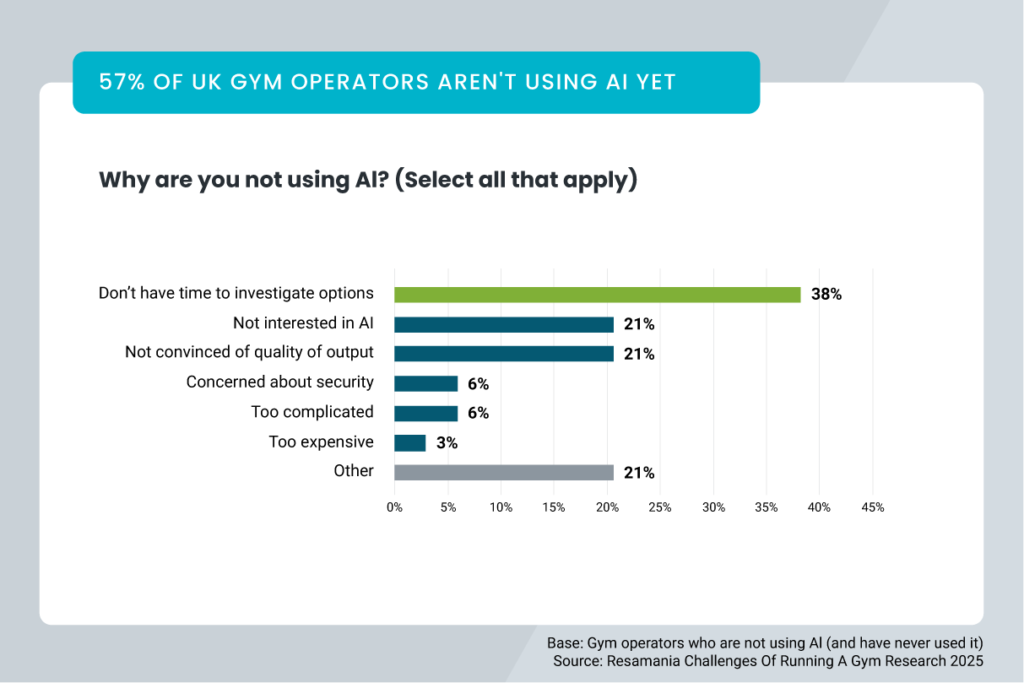
It’s an understandable position when you’re busy running a business. It also means competitors are quietly pulling ahead.
The good news is that meaningful AI adoption doesn’t need to mean a total overhaul. Among operators already using AI, the most common applications are refreshingly practical:
- Marketing content creation. Drafting social posts, emails, and campaign ideas faster, used by more than three-quarters of AI-adopting operators
- Retention and churn prediction. Spotting members who are becoming disengaged early enough to act
- Business performance insights. Turning operational data into clear, actionable answers without hours of manual reporting
- Smarter lead follow-up. Responding to enquiries instantly, including outside normal working hours, without adding to the sales team’s workload
- Personalised training and nutrition programmes. Tailoring these programmes to suit a member’s personal goals and preferences, even for scaled businesses
Strategically using AI
Much like with other tech solutions, the operators getting real value are the ones being selective:
- Picking one clear business challenge
- Choosing a solution built for fitness
- Building from there
AI works best as a partner to your people, taking on the repetitive tasks so your team can focus on relationships and service.
For operators running multiple locations, that consistency, the same standard of follow-up and insight in every location, is often where AI earns its keep fastest.
It’s also worth keeping a healthy dose of human judgement in the loop. AI is excellent at crunching data and spotting patterns at speed. The people in your business still bring context and nuance that a model can miss.
How gym operators are using AI today
Go deeperAI is here. More gym operators than ever are finding impactful ways to apply AI within their businesses. Are you? Find out how to make AI work for your business.
Get stuck in!
4. Fitness for women takes centre stage
Women’s health has moved from a niche topic to a mainstream priority for the fitness industry.
The Global Wellness Institute named 2026 as the year of women in wellness. With women typically spending more on health than men and growing scientific focus on female-specific health, this is one of the clearest opportunities in the sector.
It’s already playing out on the ground.
Total Fitness’ dedicated Women’s Gym concept reached capacity, with the operator introducing capped memberships and a waitlist to manage demand and protect the experience. That’s a strong signal for any operator weighing up whether women-only spaces, classes, or programming deserve a bigger share of investment.
This isn’t only about dedicated spaces. It’s part of a broader shift towards understanding what different member groups actually need.
Exploring opportunities to step up
Female health. Beginner-friendly strength training. Something else entirely. Operators who get specific tend to build the kind of loyalty that shows up in retention numbers, as well as sign-ups.
If you haven’t already, it’s worth asking:
Where in your current offering could women’s health be better served? And what would it take to act on that?
That might mean a dedicated space. It could be as simple as reviewing induction pathways, class timings, or marketing language to make sure women members feel this is genuinely built for them.
Given how quickly demand is showing up in the data, operators who move early are likely to build the strongest loyalty in this space.

5. Scaling brand strength without losing your local feel
As fitness businesses grow, whether through new company-owned sites or franchise expansion, a familiar tension shows up: how do you scale a strong, consistent brand while keeping the local feel that makes members loyal in the first place?
Brand strength helps attract members as you open new locations. It’s rarely what keeps them coming back.
That comes down to something harder to manufacture, a genuine sense of community and connection at the location level.
Applying consistency where it matters
Operators who’ve scaled successfully without losing that local feel tend to prioritise one thing above all. And that is two-way communication between the central team and the people on the ground.
Overarching brand standards and best practices get set centrally, but frontline teams are genuinely listened to. So, local nuance gets factored in and good ideas from one site can be spotted and rolled out elsewhere.
The aim isn’t uniformity for its own sake. It’s consistency where it matters (the standard of experience a member can expect at any location) alongside room for each site to have its own personality.
This is also where having visibility across your whole business earns its keep. Track performance, engagement, and member feedback at both the individual site level and across the group. So, it becomes far easier to spot what’s working locally and worth replicating elsewhere, rather than relying on word of mouth between managers.
The most comprehensive list of fitness industry trends to be across
Go deeperFrom wearable tech to wellbeing, and everything in-between! Find out how your gym business can make the most of the opportunities that the biggest fitness trends present.
Get stuck in!The wrap up…
Here’s a quick recap of the 5 biggest priorities shaping gym businesses right now:
- Tech that actually delivers. Adoption isn’t the same as success. The operators winning with tech set realistic expectations, frame the problem before buying, and plan for adoption from day one
- Usage is up, capacity is the challenge. Demand is booming across the industry globally. Focus on yield, secondary spend, and smarter use of space to manage growth without compromising experience
- AI moves from buzzword to daily operations. More gym operators than ever are already using AI. Most often for marketing, retention, and business insights. Starting small and staying strategic beats trying to do everything at once
- Fitness for women takes centre stage. Female health is one of the clearest growth opportunities in the industry right now. Demand for dedicated spaces and programming is already outpacing supply in some businesses
- Scaling without losing your local feel. Brand strength attracts members; local connection keeps them. Strong internal communication between central and frontline teams is what makes growth sustainable
Each priority in this list points to the same underlying truth – the operators pulling ahead are the ones making informed, deliberate decisions, rather than reacting to hype.
That gets a lot easier when your tech stack gives you the data and flexibility to act on it.
Ready to see how the right gym management software can help you respond to what’s next? Find out what’s possible for your business with Resamania in place.

by James Barter Head of Partnerships at Resamania
-
First published: 01 September 2026
Written by: James Barter