

Almost three quarters of gym operators are experiencing positive growth right now. In this article, we uncover how you can grow your business, even without opening a single new location.
The Fitness Industry Growth Report 2027 found that an impressive 74% of fitness operators have experienced strong or moderate growth over the last 3 years.
Some of this growth has been driven by new openings (68% of multi-site operators have opened a new site in the same period). Yet, expanding into new sites isn’t the only route to growth.
With operating costs rising, competition intensifying, and new clubs continuing to enter many local markets, opening another location can come with many challenges.
Some of the most successful fitness businesses are finding smart ways to generate more revenue, improve profitability, and grow member lifetime value from the locations they already have. This is contributing to the growth these businesses are experiencing.
Looking to grow your existing locations? Here are 5 opportunities that can help you drive growth right now.
Let’s get stuck in!
1. Get more from your marketing
Growth starts with a healthy pipeline of prospects and an engaged member base. Marketing can play a significant role in this. Yet, many fitness businesses struggle with marketing resources, lead generation, and campaign performance.
In the UK alone, 26% of operators who shared a promotional challenge said resources were a struggle in one way or another. And 40% of UK gym operators using email for marketing say low conversion rates are a key obstacle.
If this sounds familiar, rather than simply increasing your marketing spend, focus on improving efficiency. When it comes to email marketing:
- Segment your audience (instead of sending the same message to everyone)
- Automate lead nurture journeys so prospects don’t fall through the cracks
- Use behavioural data to personalise campaigns
- Follow up quickly when somebody enquires or starts an online joining journey
- Prioritise email marketing, which remains one of the most cost-effective channels available to fitness businesses
Growth isn’t always about generating more leads. Sometimes it’s about converting more of the leads you’re already attracting. A small improvement in conversion rates (especially when scaled across multiple locations) can create a significant increase in memberships without increasing your advertising budget.
30+ marketing ideas
Go deeperStand out from the crowd, attract members, and keep them coming back for longer with the right marketing mix. Get inspired with winning marketing ideas that will set you up for growth.
Get stuck in!Across the member journey, use behavioural triggers to automate and sent relevant email, SMS, and even in-app messages. So, members are consistently engaged at key points in their journey.
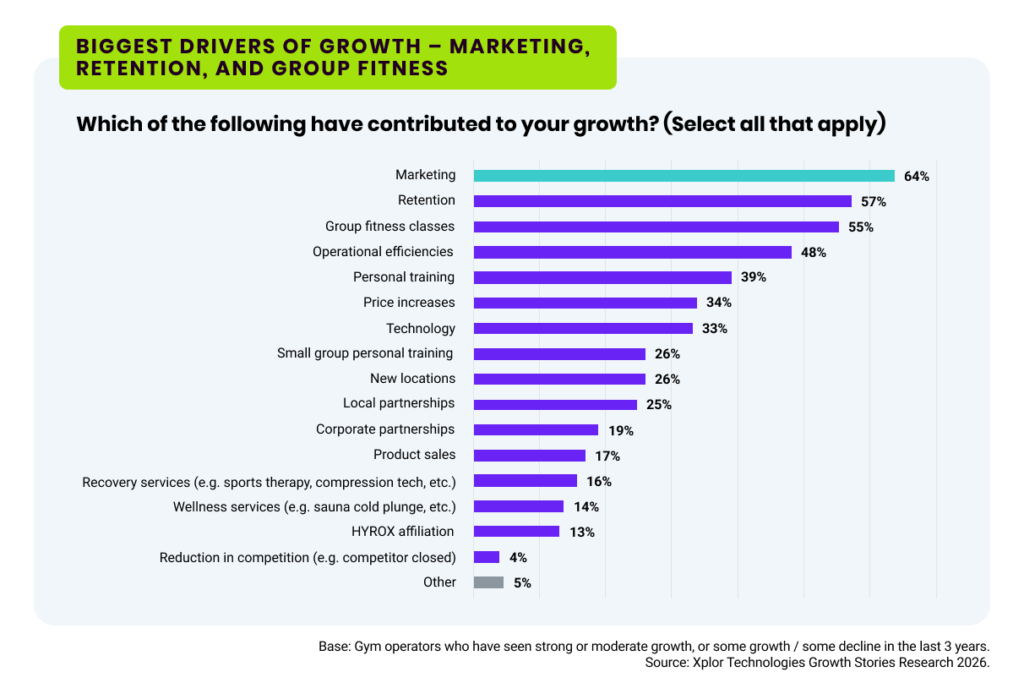
Positively, 64% of fitness operators who’ve experienced growth in recent years said marketing contributed to that growth. Sharpening your approach to marketing can be a serious growth driver.
2. Focus on retention before acquisition
Most operators naturally spend more time thinking about attracting new members than keeping existing ones.
However, retention is where sustainable growth really happens. In fact, 57% of growing fitness operators say retention has been a driver.
Commonly quoted research shows that acquiring a new member can cost between five and twenty-five times more than retaining an existing one. Meanwhile, increasing retention by just 5% can significantly improve profitability.
Despite many growing operators saying retention has played a role in growth, many still struggle with retention. 82% of gym operators in the UK have reported retention challenges of some kind.
The good news? Improving retention often requires refinement rather than major investment. Small improvements over time add up to significant retention gains.
Consider focusing on:
Strengthening onboarding
The first 90 days are critical. New members who quickly build a habit of attending are much more likely to stay long-term. Effective onboarding, inductions, milestone communications, and goal-setting conversations help create that habit.
Playbook: New member onboarding
ResourceGet the ingredients for a successful onboarding journey, know what to send (and when), and benefit from 20+ ready-to-use email and SMS templates for each point in the journey.
Get stuck in!Identifying at-risk members early
Attendance is one of the strongest indicators of retention. Members who stop visiting frequently or change their habits are more likely to quit. Tracking visit activity and running re-engagement campaigns helps to prevent cancellations.
Playbook: Re-engaging at-risk members
ResourceAccess everything you need to build an effective strategy to re-engage at-risk members – including 9 ready-to-use (or adapt) email templates.
Get stuck in!Personalising the member experience
Today’s members increasingly expect tailored experiences. As a starting point, put in place automated communications based on attendance, goals, and behaviour to make members feel recognised and valued.
Ultimately, boosting retention will boost your bottom line. The longer members stay, the greater their lifetime value becomes, and the less pressure there is to constantly replace departing members.
3. Use group fitness to increase engagement and revenue
Group fitness is so much more than a timetabling necessity. Done well, it can be one of the most powerful growth engines in your business. 55% of operators who reported growth named group fitness classes as a factor in that growth.
Done well, group exercise creates something that equipment alone cannot: community. It helps members build connections, develop accountability, and become part of something bigger.
Recent research shows members who attend selected classes:
- Stay 39% longer than other members
- Are 88% more likely to be active after 12 months
- Generate a 27% higher lifetime value than other members
Beyond traditional classes, many operators are achieving strong growth through:
- Small group personal training
- Strength and conditioning programmes
- Specialist wellness sessions
- Recovery and mobility classes
- Premium limited-capacity experiences
Specialist classes like these work well as part of premium membership tiers, as bolt-ons to standard memberships, and recurring courses that members can subscribe to. All ultimately generating additional revenue, as well as maximising the earning potential of your existing spaces.

4. Review membership options and pricing strategy
When operators think about growth, pricing is often overlooked.
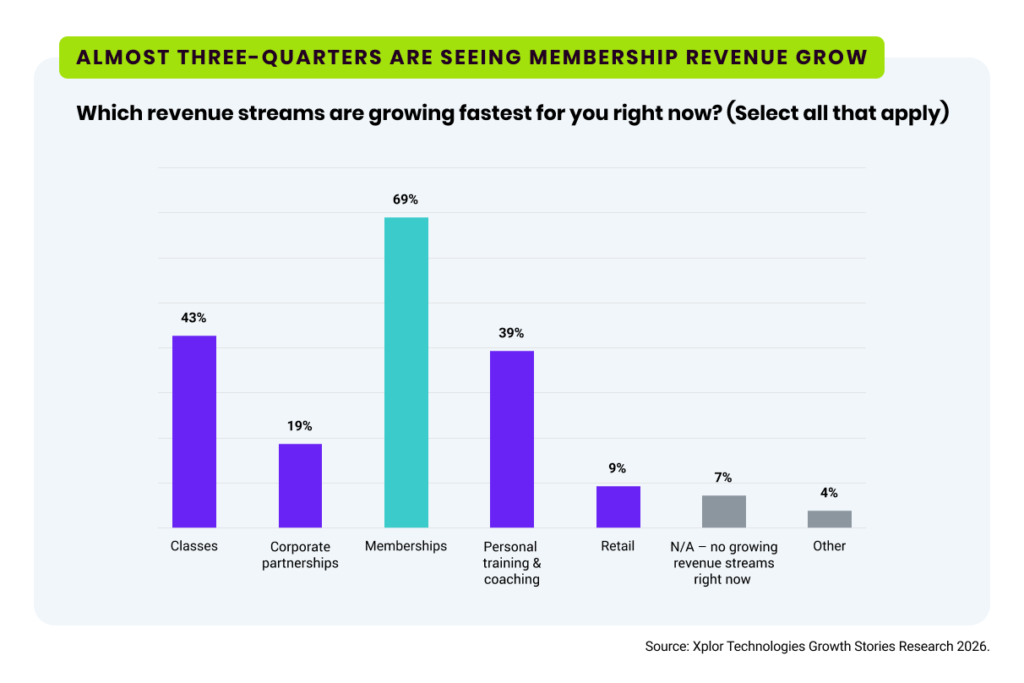
Yet research found that 68% of UK operators increased membership fees, and 76% of those who did saw profitability improve as a result. Plus, the Fitness Industry Growth Report 2027 shows that 69% of operators are experiencing membership revenue growth.
Pricing should reflect the value you’re delivering. Successful operators are increasingly moving beyond a one-size-fits-all membership offering by introducing:
- Tiered membership packages
- Premium access levels
- Flexible monthly options
- Annual paid-in-full memberships
- Add-on services and bolt-ons
- Hybrid memberships that bundle digital and in-person experiences
How to increase membership prices (and keep your members)
Go deeperNervous about increasing prices? Want to maximise retention and minimise attrition? We’ve got you covered in this handy article.
Get stuck in!Ultimately, driving growth through memberships comes down to giving members more ways to find the right fit for their needs, while increasing average revenue per member.
Many operators also discover opportunities by reviewing existing members’ usage patterns. Members paying for services they don’t use may be better suited to a different package, while highly engaged members may be willing to upgrade into a premium offering.
Growth often comes from delivering more value to the members you already have.

5. Develop a strong personal training strategy
Personal training (PT) remains one of the most effective ways to grow revenue without adding new locations. 39% of operators experiencing growth said personal training has been a factor.
The challenge? Many businesses still treat PT as an isolated service rather than an integrated growth strategy.
When positioned correctly, personal training drives:
- Additional revenue
- Greater member engagement
- Faster member results
- Improved retention
- Stronger relationships between members and staff
The best opportunities often sit between traditional one-to-one PT and large group exercise. Small group personal training offers the ability to:
- Increase coach capacity
- Improve affordability for members
- Deliver better margins
- Create stronger communities
- Support member progression
Personal training can also play a crucial role in onboarding. Goal-setting sessions, inductions, progress reviews, and milestone check-ins help new members stay engaged, while creating additional opportunities to generate revenue.
Rather than viewing PT as a standalone department, many successful operators position it as a key part of the overall member journey.
Power up your business & stay in the know
The wrap up…
Opening another site may increase your footprint, but it also increases complexity, risk, and cost.
When growing your business, start by extracting more value from the locations, members, and teams you already have.
By improving marketing performance, strengthening retention, growing participation in group fitness, optimising membership options and pricing, and building a stronger personal training proposition, you can create sustainable growth. Growth that comes at relatively little cost and risk compared to opening new locations.
In today’s competitive fitness market, smarter growth often wins over bigger growth. And the businesses that focus on maximising their existing operation are often the ones best positioned to scale successfully when the time is right.
Want more growth insights? Download the complete Fitness Industry Growth Report 2027 to benchmark your own growth against operators around the world.

by James Barter Head of Partnerships at Resamania
-
First published: 09 October 2026
Written by: James Barter