

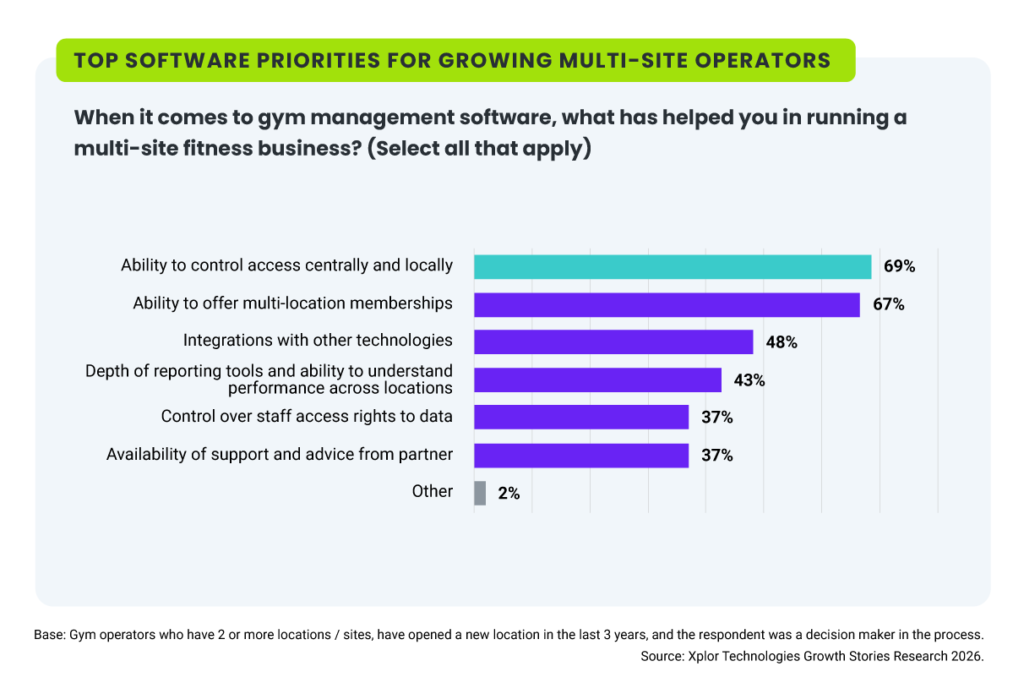
Almost half of growing fitness operators understand the value of reporting when managing multiple locations. In this article, we explore how to effectively approach reporting for confident decision-making.
Running a successful fitness business requires hundreds of decisions every week.
Those decisions matter. Whether you’re reviewing membership sales, assessing profitability, or exploring opportunities for growth, every decision has the potential to influence future performance.
As your business grows, those decisions become more complex.
Managing multiple locations ultimately means managing more data. While having access to information is important, access alone isn’t enough. The real challenge is understanding which information matters and how to use it effectively.
That’s where your approach to reporting and access to reporting become essential.
Great reporting helps you understand what’s happening across your business right now, identify trends early, and make informed decisions with confidence. For ambitious operators, reporting becomes a strategic advantage. Read on to find out how to do this.
Let’s get stuck in!
Reporting is really about decisions
All too often, leaders find themselves generating a report repeatedly because ‘that’s what we’ve always done’. The reason for generating that report gets lost – there’s no clear problem to solve or question to answer through the report.
Collecting data without a clear objective rarely leads to better outcomes.
Before creating a report, start by asking a simple question…
What decision am I trying to make?
If you’re trying to improve retention, you’ll need different information than if you want to review class usage.
The most effective operators work backwards. They start by identifying the challenge they want to solve. And then determine which questions need answering before deciding what information is required.
This approach mirrors the way successful operators evaluate technology investments. Rather than starting with features, they begin by identifying the business challenge and then selecting the right solution to address it.
Reporting should be approached in exactly the same way.

The best reports answer valuable questions
Every report should have a clear purpose.
If a report doesn’t help somebody make a decision, it probably isn’t providing much value. For example:
- If your objective is to improve profitability, you need reporting that helps you understand revenue trends, payment collection performance, and the financial health of each location
- If you’re looking to scale, you need to understand which clubs are performing best, where inefficiencies exist, and whether member acquisition and retention remain consistent across your estate
The report itself is simply a tool. Its purpose is to help answer business-critical questions and provide clarity where decisions need to be made.
When reporting is directly linked to objectives, it becomes significantly more valuable. You’ll go beyond generating information for the sake of it, creating insight that actively supports business growth.

Growth can create new reporting challenges
For growing multi-site operators, reporting matters (as shown in the Fitness Industry Growth Report 2027).
Yet, many operators discover that reporting becomes more difficult as they grow. Reporting approaches that worked perfectly well for a single-club or even a two-club business may fail to scale across more locations.
Individual sites may develop their own ways of tracking performance. Managers may create separate spreadsheets. Reports may be generated using different methods and different definitions.
The result? Inconsistency.
Multi-site operators commonly experience challenges like:
- Local workarounds
- Duplicated effort
- Limited visibility across locations
These challenges typically emerge gradually as businesses expand and become more operationally complex.
Effective reporting helps solve these challenges, creating a consistent view of performance across the business.
Rather than relying on multiple sources of information, operators can access consistent, reliable data that supports confident decision-making at every level. This reduces admin work and empowers leadership teams to focus more of their time on strategic priorities.

Key areas for multi-site operators to monitor
Once you’ve established the decision or decisions you’re trying to make, it becomes much easier to work out which information you actually need.
For many multi-site operators, the challenge is separating the metrics that genuinely influence business performance from those that are merely interesting to look at. Effective reporting focuses attention on the areas that have the greatest impact on growth, profitability, member experience, and operational efficiency.
While every fitness business is different, there are common areas that deserve consistent attention.
Membership sales and growth
If growth is one of your strategic priorities, reporting should help you understand how many memberships you’re selling and – importantly – what’s driving those results.
For example, comparing lead volumes, conversion rates, and new memberships across locations can help identify trends that would otherwise remain hidden. One club may consistently outperform the rest of the group. Another may be generating plenty of enquiries but struggling to convert prospects into members.
Without reporting, these differences can easily be missed.
With the right visibility, you’ll be able to:
- Identify successful sales processes
- Share best practice between locations
- Make informed decisions about where extra support or investment is needed
For growing operators, reporting should provide insights that help answer questions such as:
- Which locations are growing fastest?
- Which sales channels are performing best?
- Where are potential opportunities being missed?
Questions like these power meaningful action and long-term growth.
Member retention
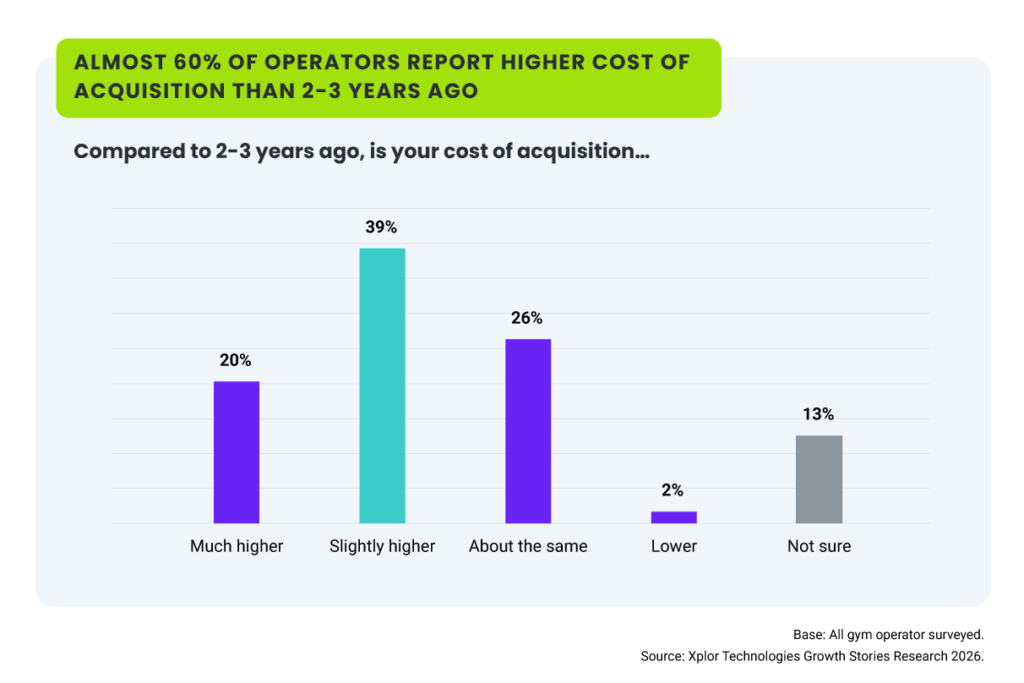
Most operators understand that acquiring new members is important. However, acquisition is expensive – in fact, almost 60% of operators report that the cost of winning new members is higher than 2-3 years ago.
So, long-term profitability often depends on keeping existing members engaged. That’s why retention reporting deserves a prominent place in any reporting strategy.
Rather than waiting for membership cancellations to arrive, effective reporting helps you identify warning signs early. This could include:
- Non-attendance
- Failed payments
- Reduced engagement with communications
- Other indicators that suggest members may be at risk of leaving
Playbook: Re-engaging at-risk gym members
FREEGet the ingredients needed to build an effective strategy to re-engage at-risk members who may leave soon – including 9 ready-to-use (or adapt) email templates.
Get your copyThe aim is to find ways to improve retention.
Understand which locations have stronger retention rates. Which member groups are most likely to disengage. And which interventions are having a positive impact. So, you can make smarter decisions that improve member loyalty and protect recurring revenue across locations.
Playbook: Supercharge gym member retention
FREEKeep more members coming back for longer to boost profitability and unlock growth opportunities. This playbook gives you 9 actionable retention strategies and dozens of tactics to test.
Get your copyFinancial performance
The financial pressures facing fitness businesses continue to grow. Rising operating costs have affected many gym operators (particularly in the UK), making financial visibility more important than ever.
For multi-site operators, reporting should provide a clear understanding of financial performance. Membership revenue, payment collection rates, secondary spending, debt levels, and profitability should all be readily accessible.
However, effective financial reporting goes beyond reviewing today’s figures. It should also help inform forecasting activity. So, you understand where your business is heading.
When reliable reporting is readily available, it becomes much easier to answer questions like:
- Are we on track to meet revenue targets?
- Are our costs increasing faster than income?
- Which locations are delivering the strongest financial performance?
Good financial reporting can help you move from reactive decision-making to proactive financial management.
Operational performance
Behind every successful fitness business sits a strong operational foundation.
Members may never see the reports, workflows, and systems that underpin the business, but they will notice the impact when things aren’t running smoothly.
Operational reporting helps you understand how effectively your facilities, teams, and services are performing. This might include class occupancy, facility utilisation, access control activity, and other operational KPIs that influence both member experience and profitability.
Importantly, operational reporting often highlights opportunities that may not be obvious from financial figures alone.
A location with lower profitability may be experiencing operational inefficiencies. A club with weaker retention may have issues relating to onboarding, staffing, or engagement. Strong reporting helps uncover these root causes so that improvements can be made with confidence.
The bigger your business becomes, the more valuable this visibility becomes.

Beware of disconnected systems
Even the best reporting strategy can fall short if the underlying systems aren’t connected.
Many fitness businesses use multiple systems to manage different parts of the operation. Membership management, billing, access control, marketing, bookings, and reporting are often handled by separate solutions.
When these systems don’t communicate effectively, reporting becomes more difficult.
Data ends up living in silos. Staff spend time manually exporting information. Reports become inconsistent. And decision-making slows down.
Research among UK gym operators has highlighted that a lack of integration between systems is a common tech-related challenge. This can create duplicated work, inconsistent member experiences, poor visibility, and operational inefficiencies.
Report: UK Gym Operator Insights Report
FREEThis report is packed with unparalleled insights into the challenges that operators are facing in the UK.
Get your copyThis is why you should view reporting as part of a wider tech strategy.
The most effective reporting environments are built on connected systems that create a single source of truth for the business. When information flows naturally between systems, reporting becomes faster, more accurate, and significantly more useful.
Ultimately, the quality of your reporting will always depend on the quality of the data feeding into it.
Power up your business & stay in the know
The wrap up…
The purpose of reporting is to make better decisions.
A dashboard on its own won’t improve retention. A spreadsheet won’t increase profitability. And a KPI won’t solve a business challenge.
The value comes from what happens next.
The most successful operators use reporting to identify opportunities, prioritise actions, and continuously improve performance across their business. They use insights to strengthen member experiences, improve operational efficiency, increase revenue, and support sustainable growth.
Most importantly, they use reporting to reduce uncertainty.
When you have access to accurate, timely information, it’s easier to make decisions with confidence. You spend less time relying on assumptions and more time focusing on actions that will have the greatest impact on the business.
That’s when reporting becomes truly strategic.
Book a personalised demo today to see how Resamania can help you stay in control, uncover valuable insights, and support the next stage of your growth.

by Ollie Flegg UK Commercial Director – Gym & Payments at Resamania
-
First published: 26 October 2026
Written by: Ollie Flegg