

Growth is on the agenda for gym operators everywhere. In this article, we unpack results from our global survey of 180+ gym operators, revealing the stats, strategies, and hard-won lessons shaping fitness industry growth right now.
In all, the last few years have been good ones for the fitness industry on a local and global level.
The 2026 European Health & Fitness Report demonstrates this. The EuropeActive research found that the number of fitness club memberships held across Europe hit 75.5 million in 2025 – up 5.8% on 2024. Plus, total revenues hit €39.1 billion – up 9.1% on 2024.
ukactive reported that fitness industry revenue rose in the UK to £6.5 billion in 2025 (up from £5.7 billion in 2024) with total membership climbing past 12.2 million people. That’s around 18% of over-16s in the UK – up from 14.6% in 2022.
Across the channel, industry growth in France has been even more dramatic. Research found that fitness club sales revenue there nearly tripled between 2021 and 2024 – increasing from around €621 million to €1.7 billion. Meanwhile, Spain’s share of the population holding a gym membership has grown to roughly 16.5% – up from around 11.4% a few years previously.
Across the Atlantic, the Health & Fitness Association reported that a record 81 million Americans belonged to a gym or fitness studio in 2025 – up 5.2% on the previous year.
Operators have opened new locations, grown revenue, and found new ways to keep members coming back. But growth rarely comes without trade-offs, and the smartest operators are the ones learning from what’s worked (and what hasn’t) elsewhere.
In this article, we explore the latest trends uncovered in the Xplor Fitness Industry Growth Report 2027 and give you growth tips (plus lessons learnt) as shared directly by gym operators themselves.
Let’s get stuck in!
The biggest fitness industry growth trends
Between 16 February and 24 May 2026, the team at Xplor surveyed more than 180 gym operators across 19 countries to directly get insights from those on the ground into just what businesses are seeing right now when it comes to growth.
The result is a detailed picture of how the industry is growing, what’s driving it, and where operators are being more cautious. The full findings are discussed in the Fitness Industry Growth Report 2027 – here’s a taster of what we found:
- 68% of multi-site operators have opened a new location in the last three years. And 87% of those chose to open a brand-new club, a sign of real confidence in organic expansion
- 74% reported strong or moderate growth over the same period, with only 2% seeing their business decline. For an industry often described as tough, that’s a strong scorecard
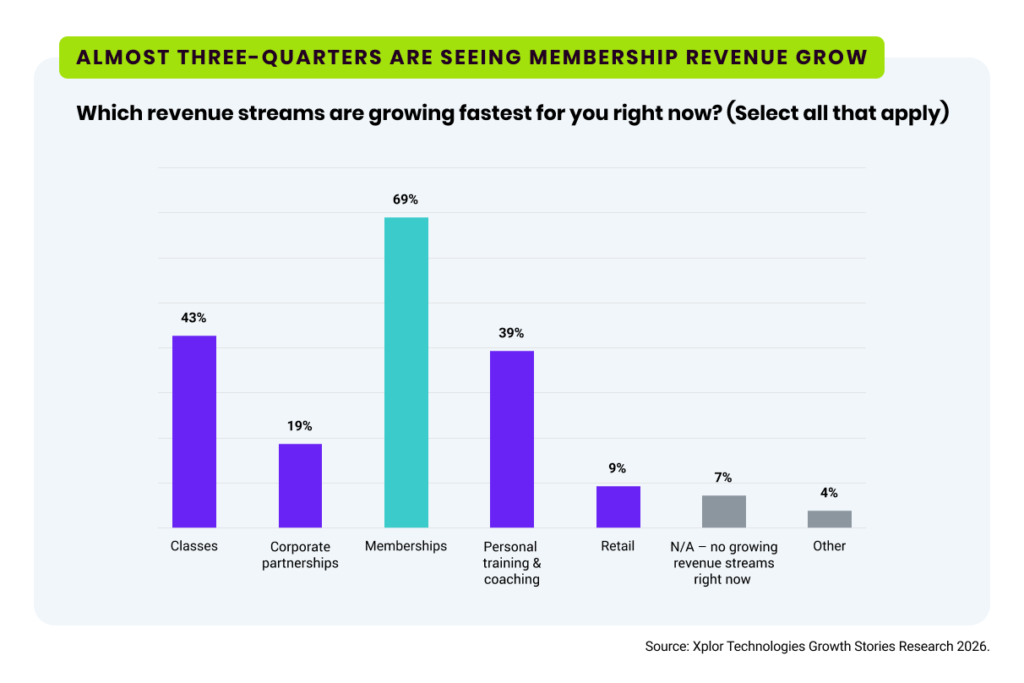
- Memberships are one of the fastest-growing revenue streams for 69% of operators, whether through volume, price increases, or new membership tiers
- 34% of those who saw some level of growth cite price increases as a direct driver of growth. Plus, several operators told us their best business decision was simply raising prices sooner
- Marketing is the number one growth driver overall, followed closely by retention and group fitness classes. Growth is rarely down to a single lever
- 37% of operators are planning to open new locations in the next one to two years, with 12% of those planning to open four or more new locations
- 58% of operators favour self-funded growth, reflecting a preference for steady, sustainable scaling over speed
- Member acquisition costs have risen for 60% of operators, making retention and referrals more valuable than ever as a lower-cost route to growth
Expansion is happening – and it’s often organic
Well over two-thirds of operators surveyed have opened a new location in the last three years, and the preference is overwhelmingly for building something new rather than acquiring an existing club.
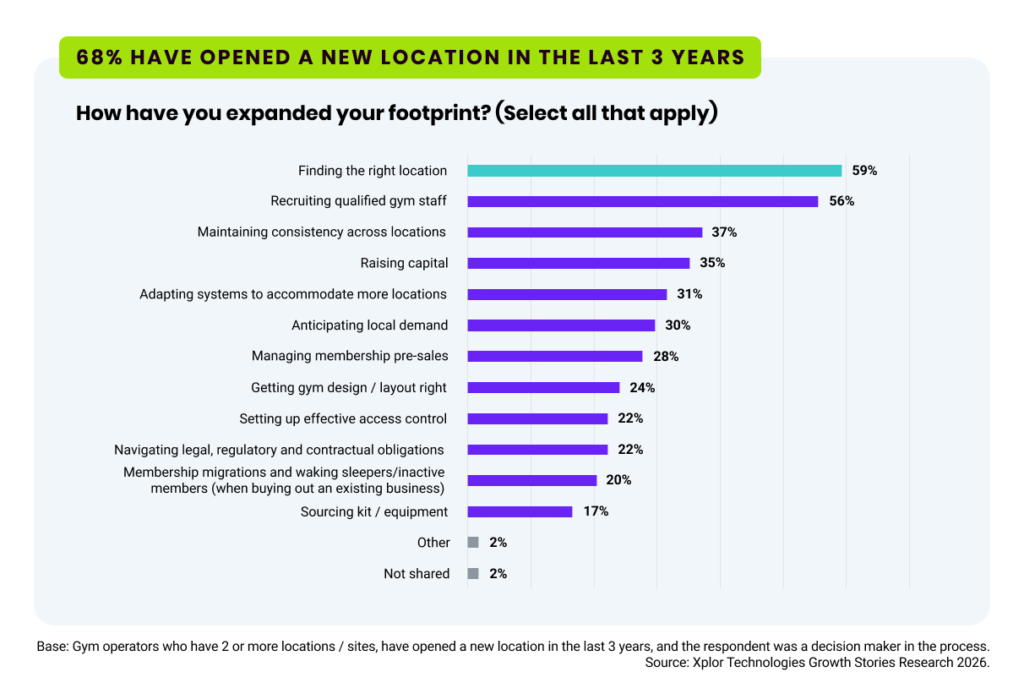
That’s a strong vote of confidence in the sector. Yet, it’s not without its challenges. Finding the right location and recruiting qualified staff were the two biggest hurdles operators faced when expanding.
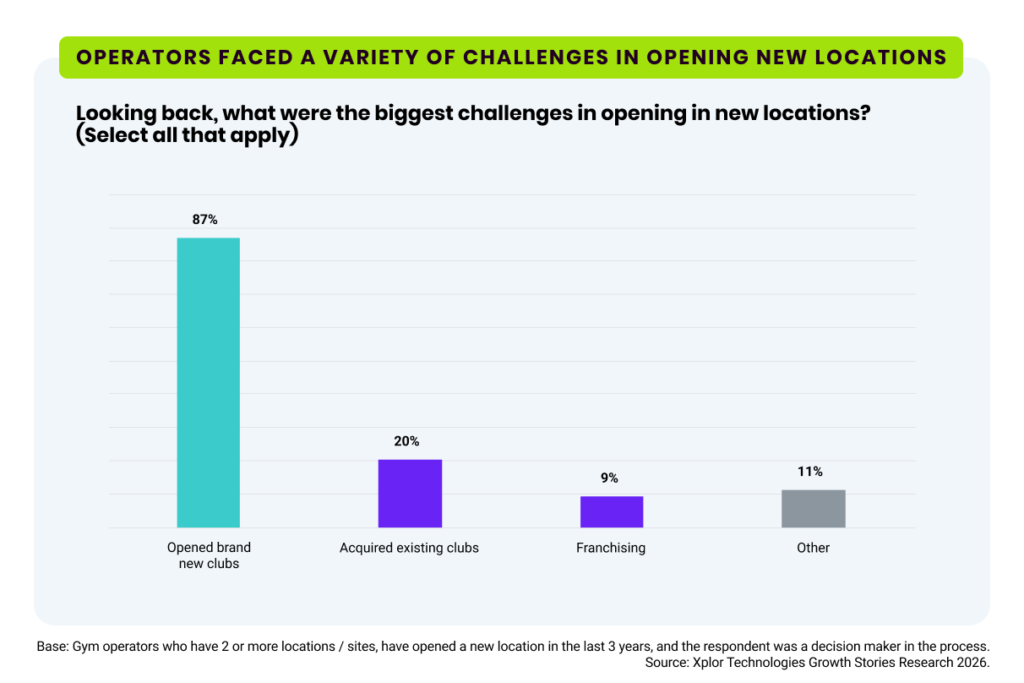
And the balance between them shifts depending on where you’re operating. UK operators, for example, ranked staffing as their single biggest challenge. While operators in France were more focused on maintaining a consistent member experience across sites.
That’s a useful reminder for any multi-site operator. The tools and processes that keep your brand consistent matter just as much as the growth itself.
When asked ‘What surprised you most when expanding to open your most recent location?’ operators shared some interesting insights.
“New members said we should be charging more.”
– Traditional gym operator with locations in the South East of England
“How long it took to build pre-sales in a new area, and that you shouldn’t always listen to ‘experts’ when your gut tells you something else.”
– Boutique fitness studio operator with locations in the South East of England
“The positive reception by customers.”
– Health club operator with locations in Spain
Growth has more than one driver
Almost three-quarters of those gym operators surveyed reported strong or moderate business growth over the last three years.
No single factor explains the growth operators have seen. Marketing tops the list, with retention and group fitness classes close behind.
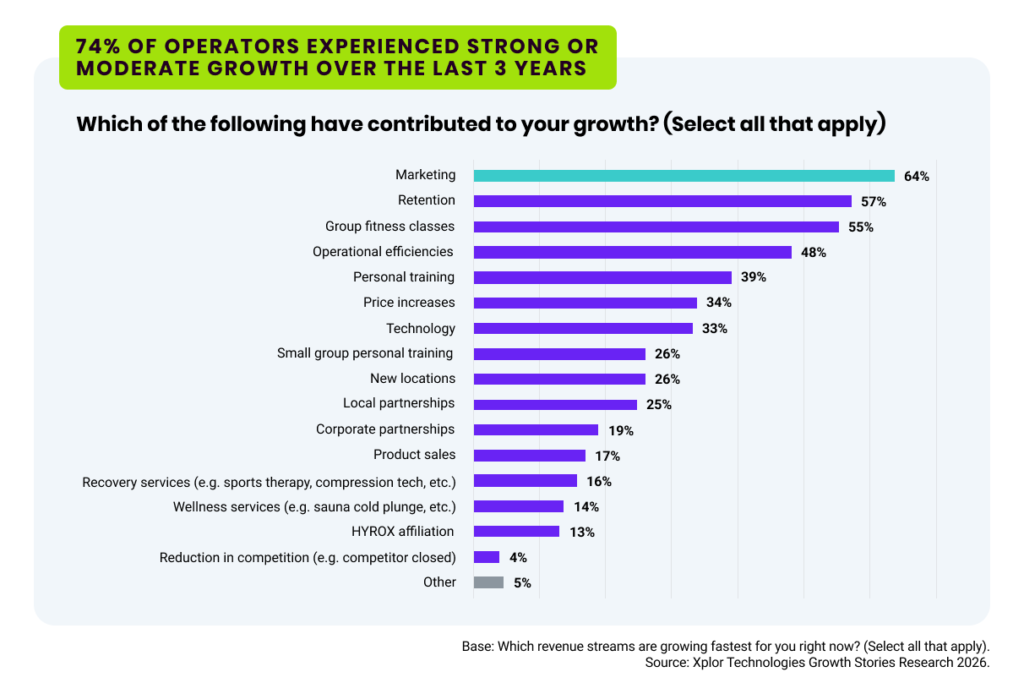
The mix of growth drivers differs by market. UK operators lean more heavily on operational efficiencies. Meanwhile, operators in France put retention a full 20 percentage points ahead of where UK operators rank it.
Despite these differences, the takeaway is the same everywhere. Growth comes from getting several things right at once, not from one silver bullet.
Some growth initiatives are delivering high returns
Operators surveyed shared some eye-opening insights into growth drivers when asked ‘Which single growth initiative delivered the best return relative to effort and investment?’.
“Efficiencies in process management.”
– Hotel health club operator with locations across the UK
“Opening times and being able to be unmanned.”
– Traditional gym operator located in Yorkshire & the Humber, England
“Customer service training.”
– Health club operator with locations in Spain, Mexico, & the US
“Increase in the number of classes.”
– Small group personal training operator located in Pays de la Loire, France
“Continually looking to innovate, annually investing 5-10% of annual turnover back into the club, creating new studios (e.g. Sweat, Pilates, outdoor spin), a café, and lounge areas, over the last 5 years.”
– Health club operator with locations in North West England
“Price increase.”
– Traditional gym operator located in Nouvelle-Aquitaine, France
Some growth initiatives are time-consuming, costly, and low yielding
At the same time, operators surveyed shared some words of caution about resource-heavy, low yielding, growth initiatives. Operators were asked: ‘Which initiative took more time or money than expected for the results delivered?’.
“Facebook marketing and Google ads are most expensive and most time-consuming to manage but they do deliver good results if managed properly.”
– Traditional gym operator located in North West England
“The ongoing training of our coaches.”
– Small group personal training studio operator located in France
“Virtual classes. Whilst investment required is low, it has only attracted existing members. This means payback period = long time but is an effective tool for retention of existing customers.”
– Public sector leisure operator with locations in Scotland
“Obtaining authorisations.”
– Boutique fitness studio operator with locations in Auvergne-Rhône-Alpes, France
“Meta ads are incredibly slow going…”
– Traditional gym operator in South East England
“One initiative that took significantly more time, energy, and money than expected for the return delivered was exploring expansion and additional premises opportunities.”
– Traditional gym operator located in the UK
“Launching SGPT.”
– Boutique fitness studio operator with locations in South East England
Memberships are doing the heavy lifting
When it comes to growth, memberships were named as the fastest-growing revenue stream by more than two-thirds of operators. Price increases played a real role too, with over a third of operators pointing to pricing as a growth factor, several said they wished they’d made the change sooner.
At the same time, acquiring new members is getting more expensive. Particularly in the UK, where 70% of operators report rising acquisition costs.
That has pushed retention and referrals into the spotlight as the more reliable, lower-cost route to sustainable growth.
The road ahead is being walked carefully
Despite the strong growth of the last three years, plans for future expansion are more measured.
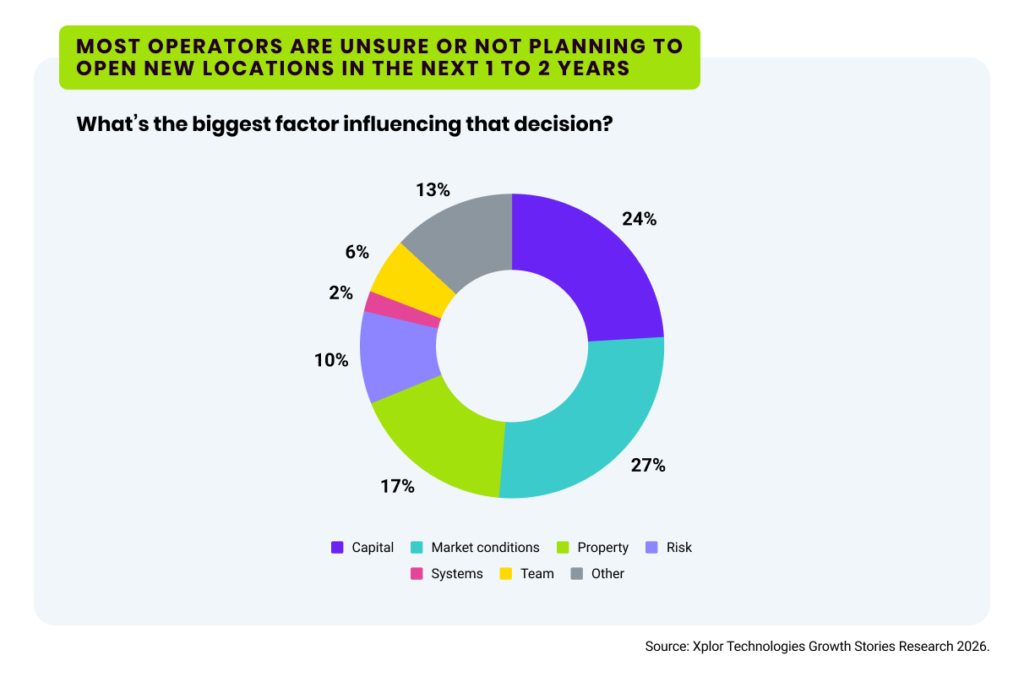
Most operators say they’re unsure or not planning new locations in the next one to two years than are planning to expand. This is largely down to market conditions, access to capital, and the property landscape.
Where operators are funding growth (of any kind), the preference is clear. 58% favour self-funded expansion, a sign that operators want to be confident in their numbers before committing to the future investments.
What operators wish they’d known sooner
Some of the most useful insights from the report come from hindsight.
Asked what growth decisions they were glad they made; operators overwhelmingly pointed to taking a strategic, considered approach of one shape or another.
What’s one growth decision you’re glad you made?
“Retain profits to fund growth.”
– Boutique fitness studio operator with locations in North West England
“Investing in good members of staff.”
– Traditional gym operator located in North West England
“To expand the business many years ago so that it does not rely on me for all the delivery.”
– Boutique fitness studio operator with locations in South East England
“Focusing on retention.”
– Traditional gym operator located in Occitanie, France
“To invest in technology to improve customer experience.”
– Public sector leisure operator with locations in Scotland
“Working with partners.”
– Health club operator with locations in Auvergne-Rhône-Alpes, France
“High price point.”
– Health club operator located in South East England
“Prioritising quality over quantity.”
– Boutique fitness studio operator in Auvergne-Rhône-Alpes, France
On the flip side, the most common warning was about growing too fast – expanding faster than the business could support drained resources and momentum.
Being too focused on price over differentiation was another common regret – a reminder that competing purely on cost rarely builds the loyalty that sustainable growth needs.
What’s one growth mistake you’d warn other operators about?
“Focusing on trends.”
– Health club operator located in South East England
“Competing on price – what really matters is the value proposition. Our DNA should define our strategy and pricing.”
– Health club operator located in Île-de-France, France
“Discounting and lowering standards.”
– Traditional gym operator located in Yorkshire & the Humber, England
“Not being careful with no-commitment offers and pay-per-session subscriptions.”
– Health club operator located in Bretagne, France
“Don’t always jump at the first opportunity, make sure you do your research and attain background information from other operators.”
– Public sector leisure operator with locations in Scotland
“Keeping prices down to compete.”
– Health club operator with locations in South East England
“Not investing in advertising.”
– Boutique fitness studio operator in France
“Not increasing membership prices in line with every other service that puts their pricing up without warning.”
– Traditional gym operator located in South East England
The wrap up…
Growth is very much alive across the fitness and leisure industry. The operators seeing the most growth are the ones pairing ambition with a clear strategy – on pricing, on retention, on staffing, and on the systems that hold it all together as they scale.
Gym management software that supports consistent access control, multi-location memberships, and a smoother sales cycle is quickly becoming the backbone of sustainable, well-managed growth.
One thing is clear, despite new and well-trodden challenges, the years to come look more exciting than ever for fitness operators around the world.
Want the full picture, including regional breakdowns for the UK and France? Download the complete Fitness Industry Growth Report 2027 to benchmark your own growth against operators around the world.

by Ollie Flegg UK Commercial Director – Gym & Payments at Resamania
-
First published: 28 September 2026
Written by: Ollie Flegg