

Every new location is a chance to welcome more members. With the right approach to access control, each site in your business feels like part of the same place. Discover how to take the hard work out of access control no matter how many locations you have.
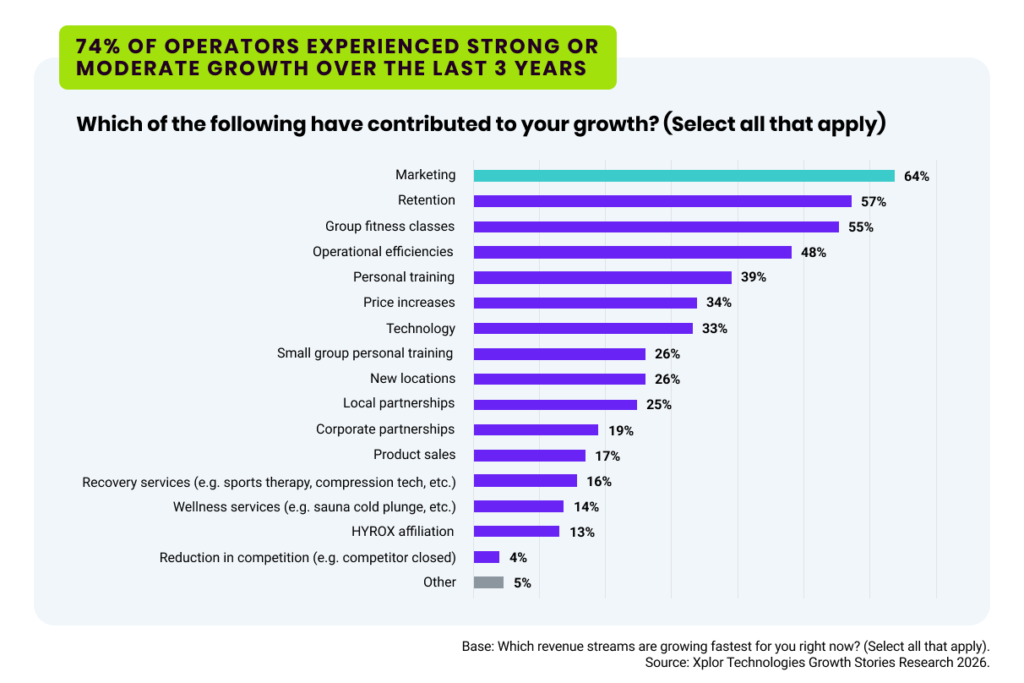
It’s been a great few years for fitness operators. 68% of multi-site gym operators told us they’ve opened a new site in the last three years. And 74% of all operators reported moderate or strong growth (just 2% said their business had declined).
Finding the right location. Recruiting the right team. Designing the right membership offer. With every opening comes a lot of careful planning. Somewhere on that to-do list sits a detail every member notices first, which is how they get through the door.
Access control may not be the most glamorous part of running a fitness business, but it shapes the member experience from the very first visit.
When it works well, nobody thinks about it. Members arrive, they get in, and they get on with their workout. When you’re running several sites, that same smooth experience needs to happen at every one of them, every time.
As operators add locations, complexity follows, and sometimes 1 + 1 = 5! That’s a good reason to build strong access foundations early.
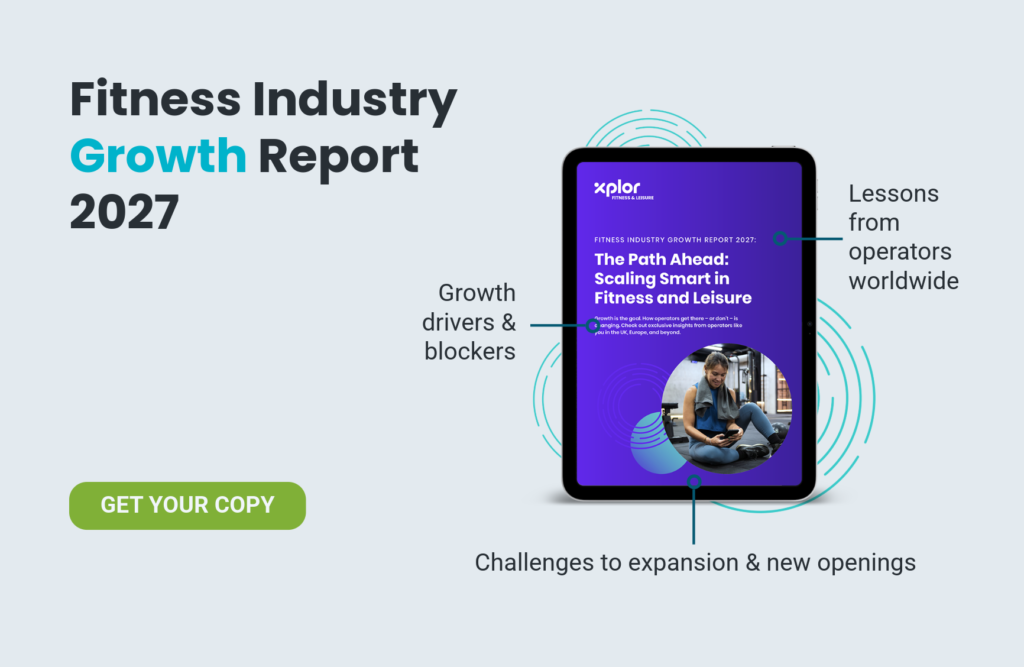
Here’s what the findings featured in the Xplor Fitness Industry Growth Report 2027 tell us about access control across multiple sites. Plus, explore how you can keep entry simple, consistent, and firmly in your control as your business grows.
Let’s get stuck in!
Why access control matters more with every new location
With a single site, access is a fairly contained topic. There’s one entrance, one set of opening hours, and one team that knows the regulars.
Add a second, third, or tenth location and the picture widens. There are more entry points, more staff with different responsibilities, and more membership types that determine who can go where, and when.
Operators surveyed for the Fitness Industry Growth Report clearly recognise this.
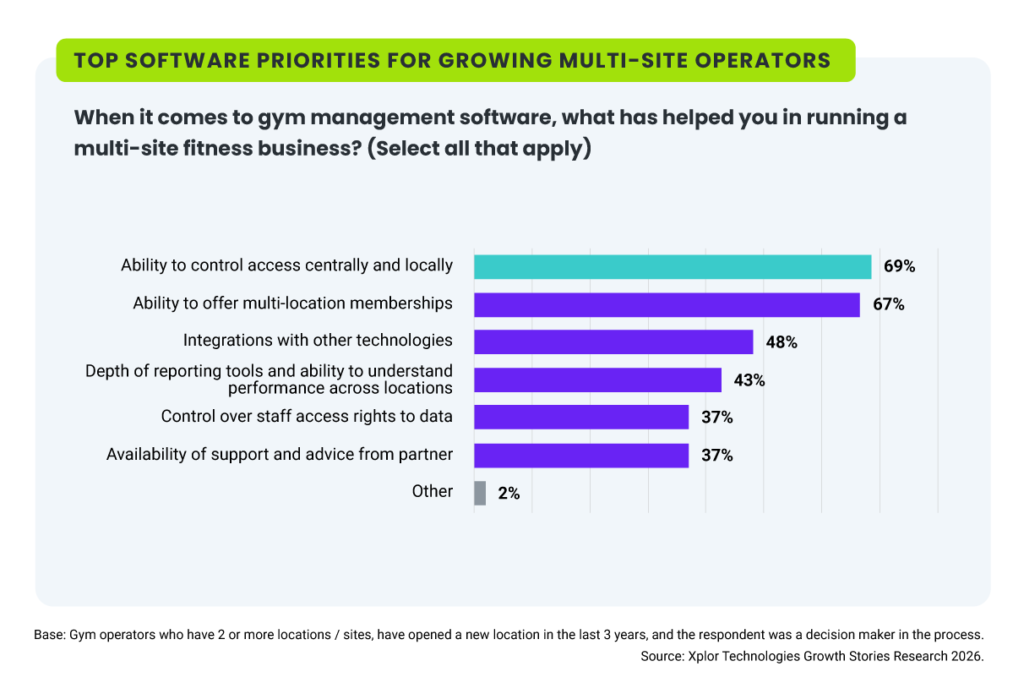
When asked what matters most in software for running multi-site locations, 69% pointed to the ability to control access centrally and locally. That was the most highly rated capability in the findings.
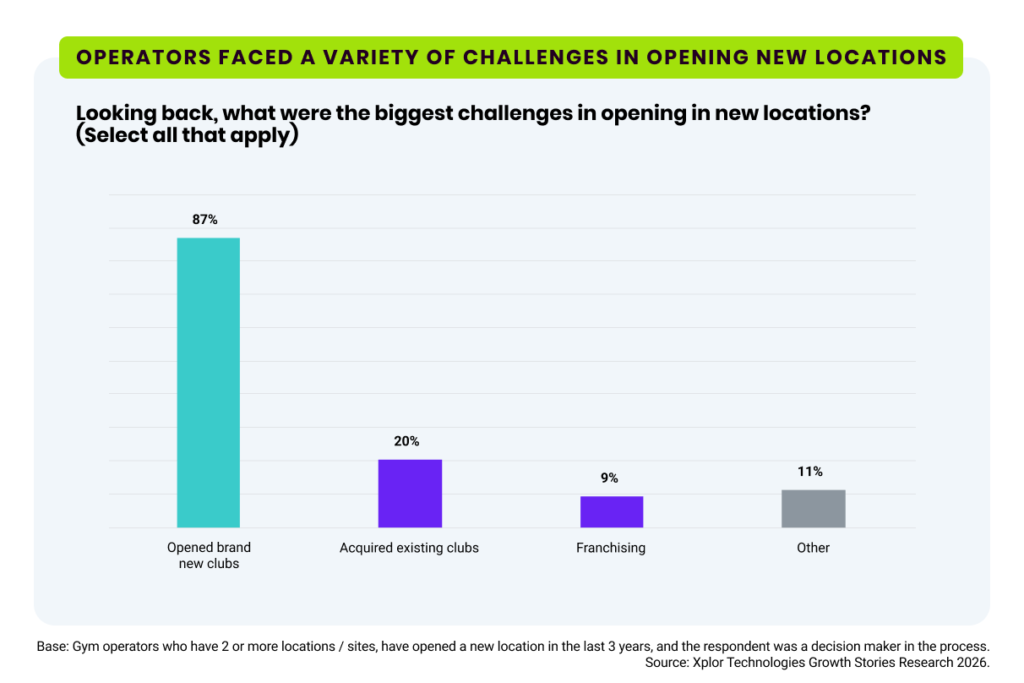
It’s also something operators come across early in their expansion journey. 22% highlighted setting up effective access control as one of the bigger challenges involved in opening a new location.
Access also connects to something operators think carefully about across locations – consistency. 37% pointed to maintaining consistency across locations as a key consideration when opening new sites. Plus, 31% said the same about adapting systems to accommodate more locations.
As one premium UK health club operator shared:
“What surprised me is how challenging it was to maintain consistent member experience and culture across both sites, even with similar systems and branding in place.”
Access is a good place to start building that consistency. It’s one of the experiences that every member has, at every site, on every visit. Get it right, and you’ve set the tone for everything that follows.

Central control, local flexibility
Central control gives you one set of shared rules, set up once, and applied across your business.
Think of the standards that should be the same everywhere. For example, how memberships grant access, how access responds to a member’s status, and who on your team has permission to make changes.
Local flexibility recognises that no two sites are identical.
Opening hours may differ. One club may have a studio or a secure area that others don’t. A site in a city centre may have very different peak times to one in a rural village.
The principle of central control and local flexibility should be supported via your gym check-in software. With access integrated into your fitness club management software (like with Resamania), you can manage access across all your facilities from one place:
- Create custom access rules that suit your business, whether you have two or 200+ clubs
- Set up schedules and restricted areas to suit each location’s needs and different membership types
- Grant appropriate access to facilities for team members
When it comes to managing access, user rights and role management within your software bring a layer of confidence. Decide which team members can view or change access settings, keeping things running smoothly as your team grows.
The same platform thinking applies beyond access.
For example, with Resamania, a service or product can be set up once and deployed to all sites or selected sites, so you’re not rebuilding the basics every time you open a new club. It’s a simple idea, and it makes expansion feel more manageable.

One member record, every location
If there’s one thing that often makes access control easier for multi-site operators, it’s the possibility of one member record and even one membership for all locations.
The Fitness Industry Growth Report found that 67% of operators rated the ability to offer multi-location memberships as important in their software.
That’s a strong signal that operators see real value in giving members the freedom to train wherever suits them. Near home on a Monday, near work on a Wednesday, or at a different site when they’re travelling.
For this to work well, access must work as well as the membership does.
A multi-location membership is only as good as the experience of arriving at a site that isn’t your usual one. If the member can walk in with the same credential they use at their home club, it feels effortless. It’s the kind of detail that makes a membership feel more valuable.
That’s why it matters that access control and membership data sit together.
With Resamania, members can access all sites (or an approved group of sites) using the same method, based on the permissions you set. That could be a dynamic QR code within your gym member app or an RFID card.
No extra step for the member, no separate system for your team to keep updated.
It also supports one of the biggest priorities in the report – retention. 57% of operators who’d seen growth cited retention as a contributor, making it the second most-cited growth driver after marketing.
When every site is easy to use, members get more from their membership, and that’s a great foundation for keeping them.

Access that keeps pace with membership
Behind every smooth entry is accurate, up-to-date membership data. When access control is connected to your gym management software, the two work in step. That’s where a lot of the day-to-day efficiency comes from.
With access control integrated into your software, which includes embedded payments, access rights update automatically based on membership status. That covers a membership starting, ending, or being frozen, as well as missed payments.
Set up access rules to address missed payments. As soon as a catch-up payment is made, the member is granted access again. It means members get a clear, consistent experience, and teams spend less time on manual checks and more time on member service.
This type of automation means fewer moving parts to manage across a growing estate, and it supports a trend that’s clear in the Fitness Industry Growth Report. Operational efficiencies were cited as a growth driver by 48% of operators who’d seen growth.
As sites are added, the processes that work well get amplified. Building efficient, automated access into your approach from the start helps those good processes scale.

Facilitating unmanned and 24/7 access
Effective, flexible access control opens possibilities for how you serve members. The ability to support unmanned hours with secure, controlled access is a starting point for reviewing your opening hours.
For multi-site operators, extended hours are an appealing way to give members more flexibility.
The right access control features within your software can also support a varied approach across your estate. Some sites might benefit from 24/7 opening, while others stay staffed during set hours.
With schedules and restricted areas managed in one place, you can tailor each location to its members, while keeping the overall approach consistent.
Look for these features to boost confidence in opening up access:
- Live, up-to-date data – Access should reflect current membership status, so only the right people get in
- Real-time tracking – If you can see entries as they happen, you’ll have confidence that you always have visibility across your sites
- Resilience – Knowing access control still works in the event of an internet outage reassures you that sites will still operate effectively, even without internet and/or staff present

Turning access data into insight
Every entry tells you something. Over time, that information builds into a rich picture of how your members use your clubs. So, it’s one of the most useful by-products of integrated access control.
With live and historic access data in your gym management software, you can track and measure attendance across sites. That means you can see:
- Which sites are busiest and when
- How usage patterns differ between locations
- How often members are visiting
It also gives you valuable information for upsell, cross-sell, and member engagement.
Practical examples of how access data can inform decisions include:
- Opening hours – Peak and quiet times can help you fine-tune hours at each site
- Class timetables – Attendance patterns show when members are most likely to be in your clubs
- Staffing – Understanding busy periods helps you put your team where they’ll make the most difference
- Future plans – Insight into how existing sites perform can help shape decisions about your next one

Questions to ask when planning access for your next location
If you’re considering adding more locations, make sure your software can accommodate access control centrally and locally, and that it offers the ability to sell multi-location memberships.
A few questions can help you put that into practice:
- Can you manage access centrally and adjust it locally? Look for shared rules with room for site-specific schedules, zones, and restricted areas.
- Can members use the same credential at every site? One QR code or card across your estate keeps things simple.
- Does access follow membership status automatically? Starts, ends, freezes, and payment updates should all be reflected without extra admin.
- Can your set-up support unmanned access and extended or 24/7 hours? Even if it’s not on your roadmap today, it’s good to have the flexibility.
- Can you see attendance by site? Live data helps you understand and improve each location.
- Does it work alongside your wider platform? When access, memberships, payments, and reporting sit together, the whole picture is clearer.
- Will it grow with you? Whether you’re adding one location or several, your set-up should make each new site easier to launch than the last.
Power up your business & stay in the know
The wrap up…
The past few years have been a great run for fitness operators, and many are looking at what comes next.
Some plan to open more locations soon. Others are taking a measured, self-funded approach to the next stage of growth. Whichever path you’re on, access control is a strong foundation to have in place.
The Fitness Industry Growth Report highlights that operators place real value on solutions that can control access and offer memberships at multiple locations. That makes sense. Access control sits at the heart of the member experience, and it connects directly to the things that often matter most for operators:
- Consistency
- Retention
- Efficiency
- A clear view of performance
With central control and local flexibility, the ability to sell a membership option that works everywhere, access that updates with membership data, and live insight into how each site is used, every new location can feel like a natural extension of your brand.
Members get a smooth, welcoming experience from the moment they arrive. Teams get more time to focus on service. And you get the confidence to keep growing.
Book a personalised demo today to see how integrated access control works within Resamania to help you stay in control of access with less effort.

by James Barter Head of Partnerships at Resamania
-
First published: 23 November 2026
Written by: James Barter